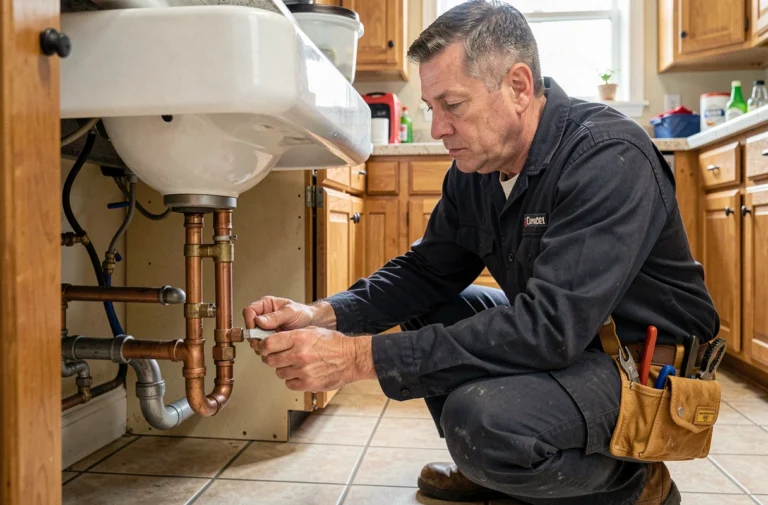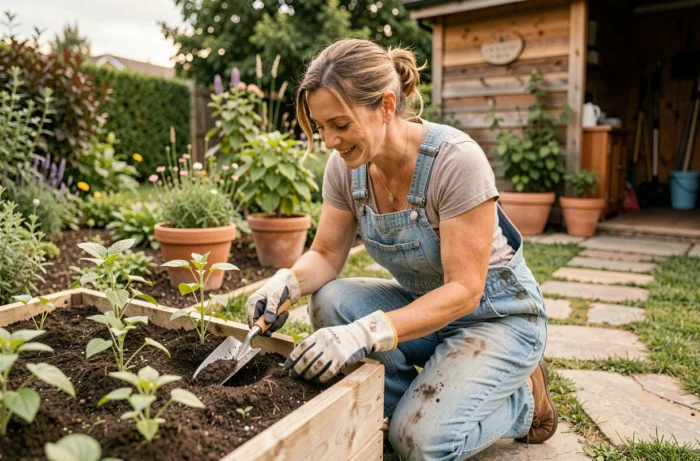
Designing a green space is not just about choosing plants and arranging them harmoniously. Garden equipment determines the quality of work, the lifespan of plants, and the time spent on maintenance. The available ranges have become more complex in recent years, with shared battery platforms, local regulatory constraints on noise, and varying watering restrictions depending on the area.
Noise regulations and motorized equipment: a framework to check before buying
Before even comparing lawn mowers or hedge trimmers, one often overlooked fact deserves attention: the permitted usage hours for motorized equipment are not uniform across France. They depend on municipal or prefectural orders and vary from one municipality to another.
A noise deemed excessive due to its duration, repetition, or intensity can constitute a nuisance even during an authorized time slot. Mowing the lawn on a Saturday afternoon at 2 PM may be perfectly legal in one city but subject to fines in the neighboring municipality.
This observation has a direct consequence on the choice of equipment. Gas models, which are noisier, pose more problems in dense residential areas. Battery-powered electric models, which are quieter, offer greater flexibility regarding these regulations. Before investing in a blower or chainsaw, checking the current order in one’s municipality can prevent costly surprises.
To get an idea of the diversity of available equipment, the equipment offered on Jardin Jade covers a wide range of tools suitable for different uses and surfaces.
Shared battery tools: the true cost of a complete ecosystem
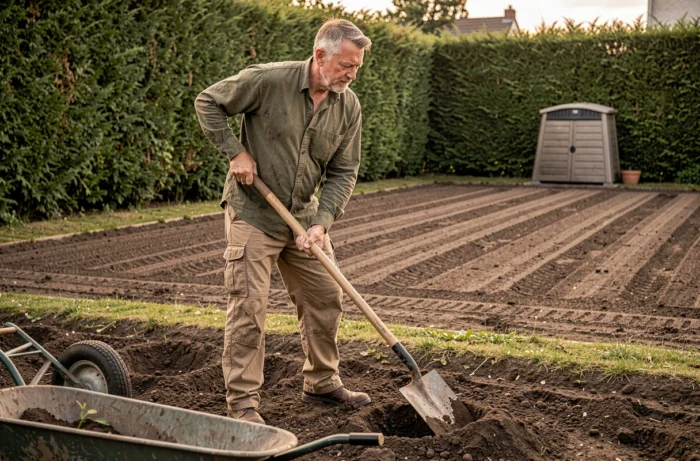
Major brands now offer ranges where a single battery powers hedge trimmers, brush cutters, blowers, and lawn mowers. The principle seems economical: buy one or two batteries and share them among the tools. However, the reality deserves a closer examination.
The entry price into a battery ecosystem exceeds that of a standalone tool. A charger and a sufficiently powerful battery often represent a significant portion of the total budget. If only one tool from the range is purchased, the additional cost compared to an equivalent wired or gas model is clear.
The economic advantage only materializes from the second or third tool purchased within the same system. Field feedback varies on this point: some users find that the autonomy of a single battery is insufficient to complete both mowing and hedge trimming in a medium-sized garden, leading to the need to purchase an additional battery.
The issue of battery repair and recycling also comes into play. Manufacturers are beginning to establish take-back systems, but the accessibility of these services remains uneven across regions.
Concrete criteria for evaluating a multi-tool system
- Real compatibility between the tools in the range: check that the manufacturer’s most common battery powers all devices, including the more demanding ones like the lawn mower
- Effective autonomy in real conditions: the durations announced by manufacturers rarely correspond to intensive use on wet soil or tall grass
- Availability of spare parts and replacement batteries over several years, as a locked ecosystem becomes unusable if the battery is no longer marketed
Water management in the garden: equipment that changes the game
Watering restrictions are multiplying and can, depending on the area, lead to the prohibition of watering certain surfaces. Garden equipment must integrate this constraint from the design stage, not just at the maintenance stage.
A rainwater collector has become a priority investment for any garden in open ground. Models range from simple above-ground tanks to underground systems connected to gutters. The choice depends on the available roof area and the volume of garden to be irrigated.
Mulching, often classified among gardening “tips,” is actually a choice of equipment: wood mulch, woven landscape fabric, pine bark. Each material has a different lifespan and a distinct effect on the soil. Wood mulch enriches the soil as it decomposes, while synthetic fabric prevents the growth of weeds without organic input.
Watering at the base, using microporous hoses or drip irrigation, significantly reduces water consumption compared to sprinkler irrigation. This type of installation requires a modest initial investment but necessitates planning the hose routes before planting.
Adapting plants to available equipment
Choosing drought-resistant plants reduces dependence on a complex watering system. Lavenders, ornamental grasses, sedums: these plants require less water and less mechanical maintenance. The right equipment does not compensate for a poor planting choice.
Soil maintenance: towards less intensive practices
The trend observed among garden managers is moving towards less frequent mowing and less compartmentalized soils. Allowing the grass to grow a few centimeters higher promotes rooting and drought resistance. This approach alters the type of equipment needed.
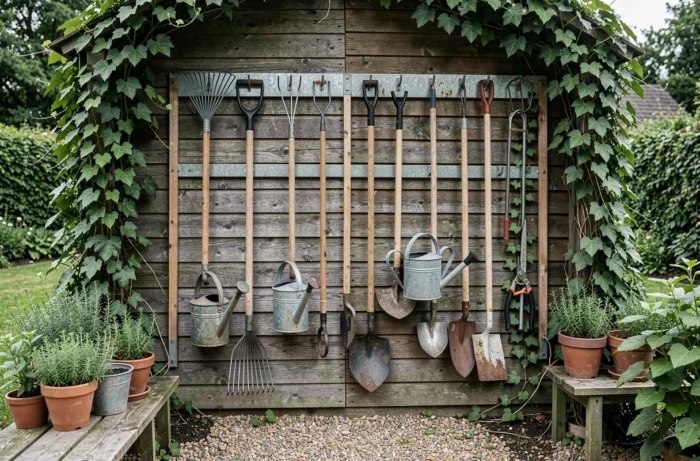
A mulching mower, which finely chops the grass and redistributes it on the lawn, replaces both traditional mowing and part of the fertilization. For soil work in flower beds, a broadfork aerates without turning the layers, preserving microbial life. The composter, whether rotating or in a wooden bin, closes the loop by transforming green waste into amendment.
- Broadfork or eco-friendly spading fork: aerates the soil without disturbing the compost fauna deeply
- Mulching mower (electric or manual reel): nourishes the lawn while cutting it
- Composter suitable for the volume of green waste produced by the garden: a model too large dries out, while a model too small overflows
- Anvil pruner for dry wood, bypass pruner for green stems: two distinct tools, not a single compromise
Designing a green space relies on overlapping equipment choices: the chosen battery system determines the available tools, local regulations guide the type of motorization, and water constraints dictate both the choice of plants and the watering equipment. A well-equipped garden is primarily a garden where the tools meet the real constraints of the land and territory.