
Turning on a faucet, flushing a toilet, starting a dishwasher: these actions involve a network of pipes, fittings, and mechanisms that most occupants of a home never see. Understanding the fundamentals of plumbing allows you to identify a problem before it worsens, communicate with a professional, or simply know what is happening behind a wall.
Sanitary protection of water networks: what the regulations require since 2023
Have you ever noticed a small valve or a backflow preventer near your water meter? This device prevents wastewater from flowing back into the drinking water supply. Since January 1, 2023, regulations require a multi-level protection on new or fully renovated installations: at the delivery point, on certain take-offs from the internal network, and at certain equipment levels.
In practical terms, this means that a simple pipe connecting the incoming faucet to your appliances is no longer sufficient. A plumber must provide appropriate backflow prevention devices for each use (washing machine, outdoor watering, boiler). The French Federation of Building published an application guide dedicated to this regulation in September 2026, indicating that the subject is still poorly understood in the field.
To delve deeper into each basic plumbing concept on the Une Autre Maison website, these sanitary protection notions provide a good starting point, as they condition the design of the entire installation.
Plumbing pipes: PEX, multilayer, or copper
The choice of piping material determines the cost, durability, and ease of installation of a system. Three families dominate the French market.

Copper: the historical material
Copper comes in two forms. Rigid copper is sold in bars and is suitable for visible passages. Soft copper is flexible, delivered in coils, and is practical for concealed passages. Its installation requires soldering (soft or hard solder), which necessitates a torch and a minimum level of skill.
Copper remains the most durable but also the most expensive to install. It resists corrosion well and withstands high temperatures, which explains why it is still found in heating circuits.
PEX: flexibility for the DIYer
PEX (cross-linked polyethylene) tubing has gradually replaced copper in recent constructions. It bends easily, requires no soldering, and connects using crimp or push-fit systems. Its price is significantly lower than that of copper.
On the downside, PEX should not be exposed to UV light, and its thermal expansion is more pronounced. For hot water, an oxygen barrier PEX should be chosen; otherwise, air can migrate into the heating circuit.
Multilayer: a rigid compromise
Multilayer tubing combines a layer of aluminum between two layers of PEX. The result: it retains the shape given to it without close support collars, simplifying visible runs. Its expansion is similar to that of copper, and it offers good oxygen tightness.
Its connection requires specific tools (crimping tool), which are more expensive than tools for standard PEX. This additional cost is justified on a complete project, but less so for a small repair.
Fittings and faucets: vocabulary to know
A plumbing network connects pipes to each other and links them to sanitary appliances. This role falls to fittings and faucets.
- Mechanical fitting (compression, olive, push-fit): it screws by hand or with a wrench, without soldering. Ideal for repairs or connections under sinks.
- Crimp fitting: it requires a dedicated tool but offers a permanent and reliable connection, used on PEX and multilayer.
- Dielectric fitting: mandatory when connecting copper to galvanized steel, to prevent corrosion due to contact between different metals.
On the faucet side, the connection diameter is standardized. Sinks generally use a diameter of 12 or 14 mm for supply, while bathtubs require a larger diameter to ensure sufficient flow. Checking the diameter before buying a faucet avoids a trip back to the store.
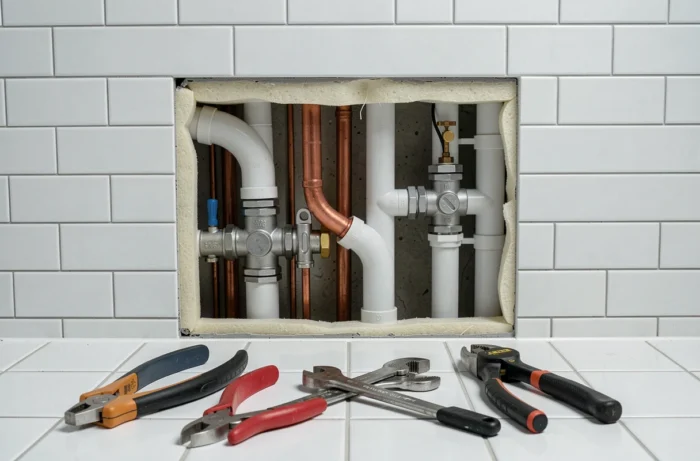
Non-conventional waters: a new regulatory framework in France
Why use drinking water in a toilet flush? This question is no longer just philosophical. The decree and order of July 12, 2024 now regulate the domestic use of rainwater, greywater (shower, sink), and even pool water.
Under certain sanitary conditions, these waters can be used for irrigation, floor washing, or feeding toilets. However, the network must be strictly separated from the drinking water supply, with clear visual identification (differently colored pipes, “non-potable water” pictograms).
For a beginner, this evolution changes the game: a plumbing installation is no longer limited to a single circuit. A home can now have two distinct networks, complicating design but reducing the consumption of drinking water.
Good practices before intervening on a system
Before touching any fitting, two checks are essential.
- Locate and test the main shut-off valve. If it is stuck or leaks when operated, repairing it becomes a priority.
- Identify the type of pipe in place. Soldering copper without training poses a fire risk. Crimping multilayer without the right tool guarantees a leak.
- Check if the intervention affects a circuit protected by a backflow prevention device. Disassembling it without restoring it exposes the network to contamination.
A ten-minute visual diagnosis can prevent water damage. Spotting signs of moisture, greenish fittings (a sign of oxidation on copper), or pipes that vibrate when a faucet is closed already gives an idea of the overall condition.
Plumbing remains a trade where approximation is costly. Knowing the type of pipes in your home, understanding the role of a backflow preventer, and knowing how to quickly shut off the water are three basics that alone can limit most domestic disasters.