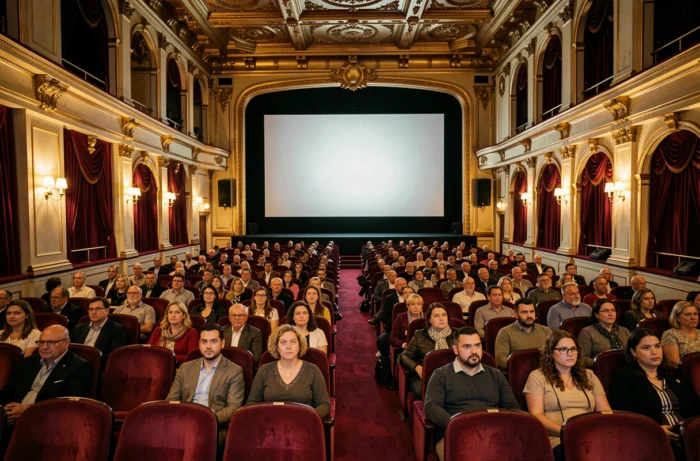
The Capitole, the historic hall of Uzès, does not just show films. Its programming combines thematic film clubs, premieres with film crews, and cinema-debate cycles with a social purpose. This combination goes beyond mere entertainment and raises the question of what an independent cinema can offer when it chooses to anchor its evenings in a broader cultural project.
Uzège Film Club: A Programming that Shapes Perspective
The 2026 season of the Uzège Film Club, hosted at the Capitole, is organized around a specific guiding theme: “Love in cinema can do without words and colors.” The principle is simple yet demanding. Each session includes a film presentation, the screening, followed by a discussion and analysis with the audience.
The selected titles set the tone: City Lights, Floating Clouds, La Strada, Sunrise. These are not films chosen at random to fill a slot. Each work engages with the annual theme and fuels the subsequent discussion.
This format transforms the cinema evening. The viewer does not just come to watch a film; they participate in a collective reading. Feedback from the ground varies regarding the level of participation in the debates depending on the sessions, but the framework exists and remains open to all audiences, seasoned cinephiles or casual curious viewers.
To consult the complete programming and the schedules for upcoming sessions, the Cinéma Capitole provides all practical information on its website.

Premieres at the Capitole: Meet Those Who Make the Film
The Capitole regularly hosts premieres in the presence of film crews. This type of event changes the very nature of the evening. Watching a film before its national release, then hearing the director or actors comment on their choices, creates a direct relationship between the audience and the creation.
The premiere transforms the viewer into a participant. The questions asked after the screening do not focus on filming anecdotes. They often touch on narrative intentions, production constraints, and aesthetic choices.
This setup is not trivial for a venue the size of the Capitole. Multiplexes also schedule premieres, but under different conditions: larger capacities, shorter exchanges, less intimacy. The Uzès venue leverages its format to offer a genuine meeting, not a promotional operation.
Cinema-Debate and Citizen Engagement: A Cycle with a Social Purpose
The Capitole has been developing a cinema-debate program with a social dimension for several seasons. The selected films address societal issues, and each screening is followed by a structured exchange.
This format raises a question rarely addressed by competitors: Can a cinema be a space for citizen debate just like a municipal hall or a cultural center? The Capitole seems to respond through practice rather than theory.
The cinema-debate requires mediation work. It is not enough to screen an engaged documentary for an exchange to take place. The quality of facilitation, the relevance of invited speakers, and the ability to accommodate conflicting viewpoints determine the success of these evenings.
What Distinguishes Cinema-Debate from a Simple Screening Followed by Questions
- A film chosen for its potential for discussion, not solely for its cinematic quality
- The presence of a moderator or an external speaker who provides additional insights (associative, scientific, political)
- A calibrated exchange time, neither too short to remain superficial nor too long to discourage participation
- A regular programming that builds a loyal audience and fosters a habit of debate
Accessibility of Cinema Halls: A Regulatory Challenge that Also Concerns the Capitole
Accessibility of screenings has become a central issue for French cinemas. The Ministry of Culture published a statement in September 2026 on the accessibility of works, venues, and cultural professions. The CNC has included this theme on the professional agenda of the sector during its September 2026 congress.
Accessibility is not limited to ramps and reserved seats. It encompasses audio description, adapted subtitles, magnetic loops for the hearing impaired, and more broadly, the ability of a venue to welcome all audiences without distinction.
For an independent venue like the Capitole, these requirements represent a technical and financial challenge. The available data does not allow for a precise determination of where the Capitole stands on each of these points. However, the regulatory framework is becoming clearer, and venues that do not anticipate may find themselves out of sync with public expectations and legal obligations.
The Concrete Dimensions of Accessibility in Venues
- Physical accessibility: wheelchair access, adapted seating with good visibility, accessible restrooms
- Sensory accessibility: audio description for blind or visually impaired individuals, subtitles for the deaf and hard of hearing, magnetic loop
- Cognitive accessibility: adapted programming (relaxed screenings with dimmed lights and reduced sound), clear signage
An inclusive cinema evening integrates these dimensions from the event’s conception, not as a last-minute addition. It is on this ground that the independent venue can differentiate itself from the multiplex, by offering personalized hospitality that larger chains struggle to provide.
The Capitole stands at the crossroads of several dynamics: a demanding cultural programming with the film club and premieres, a civic engagement with cinema-debate, and increasing obligations regarding accessibility. The ability to uphold these three commitments simultaneously will define what a cinema evening truly means at the Capitole in the years to come.