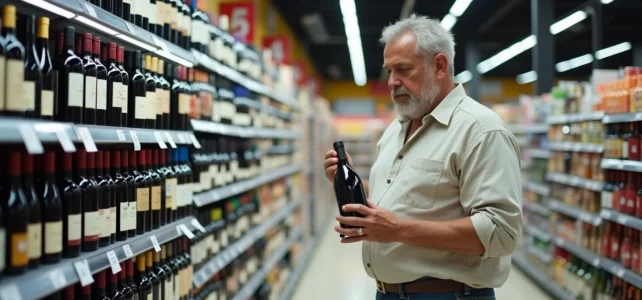
The price gap on alcohol between France and Spain has long justified trips by car to La Jonquera or Le Perthus. However, recent increases in Spanish excise taxes and widespread inflation in the eurozone have reshuffled the cards. This article measures what remains truly advantageous in 2026, product by product, and what is no longer worth the trip.
Local Spirits vs. Major Brands: Where Does the Gap Still Exist
The tightening of prices between France and Spain does not affect all categories equally. Since 2023, the increases in excise duties and retail prices in Spain have been stronger than expected for international major brand spirits (whiskies, vodkas, rums). The price advantage on these references has significantly reduced compared to the early 2020s.
On the other hand, local spirits and private label brands remain significantly cheaper on the Spanish side. A gin or brandy from a Spanish brand in a supermarket in Figueres or Girona retains a significant differential compared to its equivalent in France. For those looking to evaluate the alcohol prices in Spain 2026, it is in this specific segment that the calculation remains favorable.
Everyday wine benefits from a sustainably lighter tax structure in Spain. However, the unit difference on a bottle remains modest and only becomes noticeable when purchased in volume.
Comparative Table of Price Gaps by Product Category
The table below summarizes the trend of price gaps observed in 2025-2026 between the two countries, by product type. The qualitative data is based on recent European consumption analyses.
| Category | France/Spain Gap | Trend 2024-2026 |
|---|---|---|
| Whisky, vodka, rum (major brands) | Low to moderate | Decreasing (tightening) |
| Spanish local spirits and private labels | Marked | Stable |
| Beer in volume (packs) | Moderate | Stable |
| Everyday wine (table, bag-in-box) | Low per bottle, noticeable in volume | Stable |
| French AOC wine sold in Spain | Almost none | Not applicable |
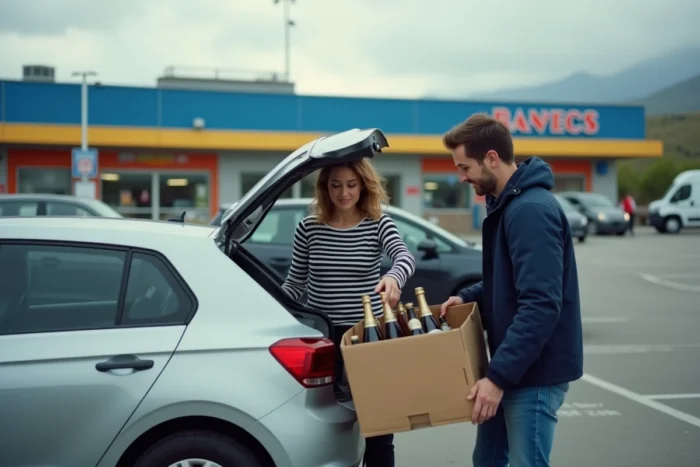
The clearest price advantage concerns local spirits and beer in bulk volumes. For major international brands, the difference often no longer covers travel expenses for a trip of more than one hundred kilometers.
French Customs Regulations: Allowed Quantities on Return
The legal framework remains that of free movement within the European Union, but French customs applies indicative thresholds beyond which proof of personal use may be required. These thresholds have not changed recently and apply per adult transporting the products in their vehicle.
- Spirits (over 22% vol.): up to 10 liters per person
- Wines (non-sparkling): up to 90 liters per person
- Beers: up to 110 liters per person
- Intermediate products (port, vermouth, etc.): up to 20 liters per person
Beyond these quantities, customs officers may consider it a commercial purchase and apply French excise duties. Crossing the border remains smooth in most cases, but checks have intensified on the Perpignan-La Jonquera route in recent years, especially during holiday periods.
Tobacco and Alcohol: Frequent Cross-Checks
Vehicles checked for tobacco purchased in Spain often undergo simultaneous verification for the alcohol transported. Both regulations apply in parallel, and exceeding one can lead to a more thorough inspection of the other.
Real Cost of the Trip: The Calculation Few French People Make
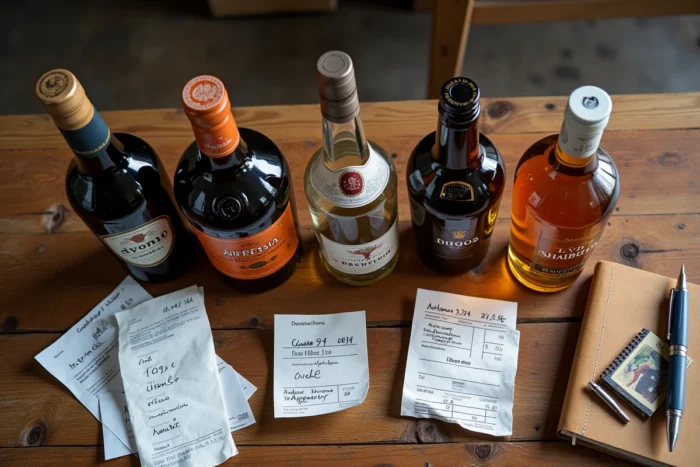
The classic mistake is to compare the price per liter without factoring in the cost of travel. For a round trip from Toulouse to La Jonquera, one must account for tolls, fuel, and vehicle wear. From Montpellier or Perpignan, the distance is shorter, and the calculation changes.
The net savings depend on the volume purchased and the distance traveled. For a purchase of a few bottles of international brand whisky, the price differential no longer compensates for the trip beyond a hundred kilometers one way. The calculation only becomes favorable again for bulk purchases of local spirits, beer, or everyday wine bought in bag-in-box.
A cross-border resident living less than thirty kilometers from the border retains a clear advantage. For others, buying alcohol in Spain is mainly justified as a complement to an already planned trip (vacation, weekend, business passage).
Spanish Promotions and Purchase Periods
Spanish supermarkets near the border (Mercadona, Carrefour Spain, Lidl) run aggressive promotions on alcohol, particularly before summer and during the holiday season. These occasional offers can recreate a significant gap, even on international brands.
Keeping an eye on the flyers from stores in Figueres or La Jonquera remains a relevant strategy to maximize savings. Seasonal promotions sometimes offset the structural tightening of prices observed throughout the rest of the year.
Buying alcohol in Spain in 2026 remains profitable in specific cases: local or private label spirits, bulk beer, and everyday wine purchased in large quantities by cross-border residents or travelers already en route. For major international brands, the gap has narrowed so much that it no longer justifies a dedicated trip. The reflex of “crossing into Spain” now deserves a case-by-case calculation, including fuel and tolls.