The health constraint of three days of storage in the refrigerator for homemade cooked dishes, as reminded by ANSES, reshapes weekly meal planning. It’s impossible to prepare seven dinners on Sunday and store them safely without risk. This limit requires rethinking batch cooking, everyday recipes, and leftover management with a rigor that most recipe sites do not incorporate.
Batch cooking and food safety: the three-day rule that changes everything
We observe that the majority of batch cooking guides suggest cooking five to seven meals in a single session. This approach directly contradicts French health recommendations: fresh cooked dishes can be stored for three days in the refrigerator, no more.
In practical terms, a preparation session on Sunday covers at best the meals for Monday, Tuesday, and Wednesday evening. For the rest of the week, two options arise: freeze part of the preparations or plan a short second session on Wednesday.
This constraint modifies the type of recipes to prioritize. Saucy dishes, vegetable gratins, or curries freeze well. In contrast, composed salads, tartares, or preparations based on raw vegetables do not tolerate freezing or prolonged storage. Adapting menus to these parameters avoids waste as well as health risks.
We recommend structuring each session around three fresh dinners and two frozen portions, rather than aiming for a full week in refrigeration. On the cooking section of Gourmandises et Bavardages, this short rotation logic is well integrated into the menu proposals.
Weekday recipes: cooking less to eat better
Preparing meals in advance does not mean multiplying recipes. We recommend starting from three versatile bases per week: one grain (rice, pasta, bulgur), one legume (lentils, chickpeas), and one seasonal vegetable roasted or steamed.
From these three bases, variations are made at the time of serving. A bowl of brown rice accompanies a vegetable curry on Monday, then transforms into fried rice with an egg and soy sauce on Wednesday. Chickpeas become a warm salad with cumin on Tuesday, then express hummus on Thursday.
The component-based approach rather than finished dishes
Preparing separate components rather than complete dishes offers more flexibility. A batch of roasted carrots can serve as a side, a tart filling, or blended into a soup depending on the day’s desire.
This method also reduces monotony. Eating the same reheated dish three nights in a row tires the palate. Assembling the same ingredients differently creates perceived variety without extra effort.
- Cooked grains in large quantities (rice, quinoa, barley): keep for three days in the fridge and freeze without significant texture loss
- Oven-roasted vegetables with a drizzle of olive oil: versatile in salads, wraps, pasta toppings, or as a side for meat
- Homemade sauces and condiments (pesto, miso vinaigrette, tahini sauce): transform a simple assembly into a complete meal in seconds
- Pre-cooked proteins (hard-boiled eggs, poached chicken, lentils): ready to integrate into any plate without additional cooking time
Delicious tips to reinvent leftovers without waste
Food waste is directly linked to the price increases observed since 2024. Reusing leftovers becomes a budgetary lever as well as an ecological gesture. A few techniques allow transforming a leftover dish into a full meal.
Leftover cooked vegetables can be blended into soups with a broth base. A leftover pasta can be pressed into a mold with beaten eggs and grated cheese to create a pasta frittata, baked in the oven in twenty minutes.
The seasonal tart as the ultimate anti-waste recipe
Savory tarts can absorb practically all vegetables nearing the end of their life. Soft leeks, slightly dry mushrooms, overly ripe tomatoes: everything blends into a classic quiche mixture (eggs, cream, salt, pepper). A homemade shortcrust pastry can be prepared in five minutes with flour, cold butter, and a bit of water.
Damaged apples follow the same principle in a sweet version. A simple apple tart, without frills, remains the most effective seasonal dessert to avoid throwing away overly ripe fruits.

Weekly menu: planning meals without falling into routine
Menu planning often encounters a pitfall: repetition. Systematically alternating between meat, fish, and vegetarian meals is not enough to maintain the desire to cook.
We recommend introducing a dish from a different cuisine each week to break the cycle. An Indian dhal on Tuesday, simplified makis on Thursday, a shakshuka on Saturday. These recipes use common ingredients (tomatoes, spices, rice, eggs) but radically change the perceived flavors.
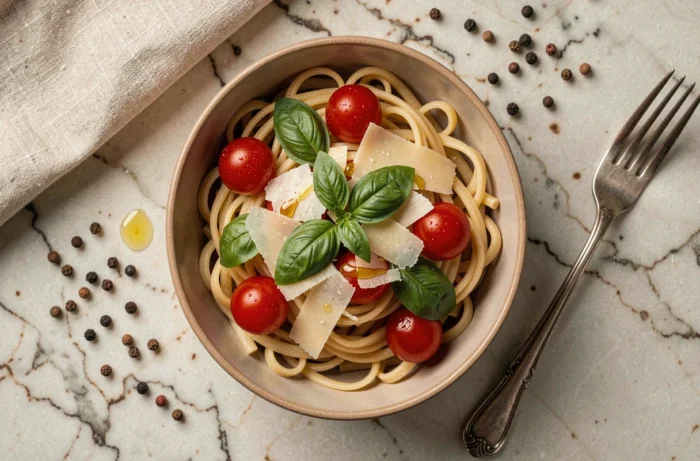
- Monday: pasta dish with weekend vegetables, tomato sauce or homemade pesto
- Tuesday: foreign cuisine based on legumes (dhal, chili sin carne, express falafel)
- Wednesday: gratin or tart with leftovers from the beginning of the week
- Thursday: cold composed meal (salad, wraps, bowls) from batch cooking components
- Friday: free recipe or outing, to relieve the pressure of planning
This framework is not rigid. It works as a basic grid that everyone can adapt to their tastes, time constraints, and available seasonal products.
The key to a sustainable daily cooking routine is not the perfection of the menu but the flexibility of the system that produces it. Three well-chosen components, a rotation respecting storage limits, and a few condiments to elevate everything are enough to cover the week without boredom or waste.