
The name Ambre derives from the Arabic word anbar, which refers to ambergris, a fragrant substance produced by the sperm whale and used in perfumery since antiquity. This Arabic etymology is often confused with the fossilized plant resin (yellow amber, succinite), creating a dual semantic lineage that most name records do not distinguish. By extension, the name also carries a connotation of immortality, inherited from its connection with Ambrose (from the Greek ambrosios).
Ambergris and yellow amber: two etymologies, one name
The confusion between the two ambers is significant for understanding the imagery associated with the name. The Arabic anbar refers to a rare animal substance linked to medieval maritime trade between the Arab world and Europe. Yellow amber, on the other hand, is a fossilized resin of plant origin, harvested along the shores of the Baltic since the Neolithic.
When the name Ambre established itself in France in the mid-20th century, these two materials were already conflated in everyday language. The result is a name with a dual register: the golden warmth of the resin and the precious scent of ambergris. We observe that it is precisely this overlap that today fuels its ranking among the so-called “solar” or “nature” names.
To delve deeper into the origin of the name Ambre, one must trace back to the Semitic root rather than the Greek, contrary to what some public records suggest.
Name Ambre in France: an atypical birth trajectory
The first Ambre recorded in France was born in 1949. For several decades, the name remained confidential, given to only a few girls each year. Growth accelerated from the 1990s, driven by the trend of short names and the popularity of sounds ending in “-bre” and “-re”.
Ambre reached a peak of popularity in 2022, a year in which it firmly established itself in the top three of female names in France. In 2024, it occupies the third position in the national ranking, with over 2,800 births recorded.
This stability at the top of the rankings distinguishes Ambre from names with a meteoric trajectory (rapid rise, rapid fall). It is a plateau name: after the upward phase, assignments remain high without a sudden collapse. This demographic behavior suggests that the name has transitioned from a “trend” status to that of a “contemporary classic”.
Geographical distribution and regional variants
Ambre is not evenly distributed across the territory. We observe an overrepresentation in the Auvergne-Rhône-Alpes region and in the southeast of France, which coincides with the solar and Mediterranean imagery of the name.
In French-speaking Belgium, Ambre also ranks among the most commonly assigned female names, confirming its grounding in the Francophone space beyond metropolitan France.
Solar name and nature trend: why Ambre is set to thrive in 2025
The name rankings for 2025-2026 consistently place Ambre in the category of solar and luminous names, alongside Elio, Alba, or Nour. This positioning goes beyond simple etymology: it reflects a deeper trend among parents, who favor names evoking warmth, light, and natural materials.
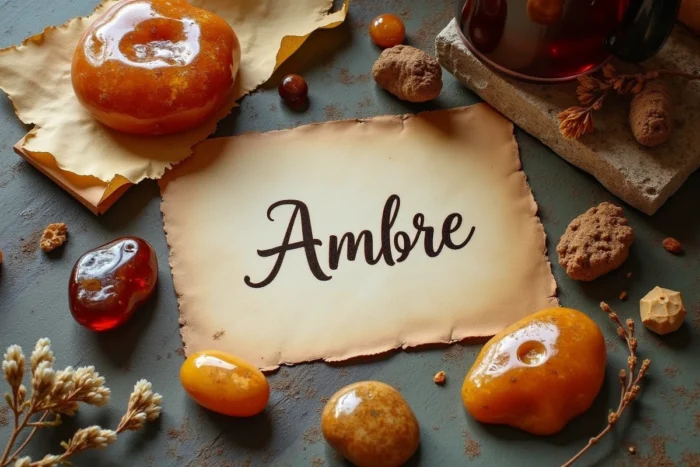
On social media, creators specializing in names (TikTok, Instagram) present Ambre with a precise visual universe: golden hues, resin textures, summer ambiance. This aestheticization contributes to fixing the image of the name in a sensory register that civil status records do not capture.
- Recurring association with golden color and warm tones in visual content dedicated to names
- Systematic presence in selections of “nature names” and “radiant names” for 2025-2026
- Consistency with the broader trend towards short names (4-5 letters), seemingly unisex, with a strong sensory charge
This phenomenon is not trivial. The visual imagery of a name now influences parents’ choices as much as its sound, which explains the longevity of Ambre in the rankings.

Meaning of the name Ambre: beyond the etymological record
The meaning commonly attributed to Ambre is summarized as “ambergris” or “fossilized resin.” This strictly material reading overlooks an older layer of meaning.
The connection with the Greek ambrosios (immortal, divine) is not a mere phonetic coincidence. It structures the semantic field of the name in Romance languages and gives Ambre a dimension that transcends the simple name of a material. In onomastics, Ambre is part of the names-materials with dual etymology, like Jade (stone and entrails in Spanish) or Agatha (good and fine stone).
This particularity explains why the name works well in different cultural contexts:
- In the Arabic context, anbar refers to perfume and maritime trade
- In the European context, amber evokes the Baltic, fossilization, and golden color
- The link with ambrosios adds a connotation of immortality, valued in Christian cultures through Saint Ambrose
Feast and patron saint
The feast of Ambre is celebrated on December 7, the date of Saint Ambrose of Milan, a doctor of the Church from the 4th century. The name Ambre does not have its own saint: it is etymologically linked to Ambrose, which is common for female names derived from masculine Latin forms.
Parents who choose Ambre in 2025 rarely do so for this religious reference. The name has largely secularized, and it is its grounding in natural and luminous imagery that motivates the decision, much more than the saints’ calendar.