A room where one feels uncomfortable for no apparent reason, restless sleep since a move, a persistent heaviness in the living room: these sensations lead many people to seek ways to purify their interior. Before burning anything, there are concrete actions, rooted in ancient practices as well as common sense, to restore a peaceful space.
Ventilation and natural light: the foundation before any purification ritual
Have you ever noticed that a room closed for several days gives off a heavy atmosphere? It’s not just an impression. Stale air concentrates humidity, odors, and particles that contribute to this feeling of stagnation.
Opening the windows wide for about fifteen minutes, ideally creating a cross breeze (two opposite windows), tangibly renews the atmosphere of a room. Cross ventilation is the first gesture of energetic cleaning, well before fumigation or salt.
Natural light plays a complementary role. Pulling back the curtains, clearing the window sills, and letting the sun in immediately changes the perception of a space. Recent guides on home purification emphasize this often-overlooked step: decluttering access to light transforms the ambiance without any accessories. Those who wish to drive away bad spirits from the home benefit from starting with these simple gestures, which lay a healthy foundation for everything that follows.
Purification through sound: bells, Tibetan bowls, and hand claps
Most articles on the subject focus on fumigation (sage, palo santo, incense). Sound rituals, however, remain underrepresented even though they are accessible to everyone and produce neither smoke nor residue.
How sound affects the atmosphere of a room
The principle is straightforward: produce a clear vibration in every corner of the room to “break” the feeling of stagnation. The Tibetan bowl, the bell, or a simple clap of hands is sufficient. Start at the entrance, then move through each room clockwise, paying particular attention to corners, closets, and less frequented areas.
Hand claps are the most rudimentary method, but also the most universal. Three to five sharp claps per corner of the room, listening for the resonance. A dull and muffled sound in a specific corner encourages more attention there.
Tibetan bowl or bell: which tool to choose
The Tibetan bowl produces a prolonged and enveloping sound, suitable for large living spaces. The bell, more striking, is better for narrow hallways and passage areas. Neither is superior to the other; the choice depends on the layout of the home and personal sensitivity.
- Tibetan bowl: gently strike the rim with a mallet, then rotate it to prolong the vibration. Ideal for the living room, bedroom, or office.
- Bell: shake firmly in each corner of the room. Effective in entrances, hallways, and rooms where air circulates little.
- Hand claps: no equipment needed, immediately actionable. Preferable for a quick initial cleaning or as a complement to another method.
Coarse salt and fumigation: often forgotten precautions
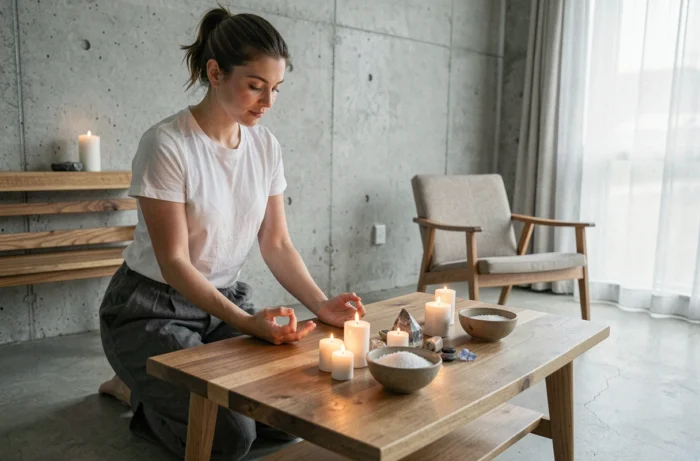
Coarse salt placed in bowls at the corners of a room is the most cited technique for purification. The principle is simple: salt would absorb accumulated negative energies. It should be replaced weekly by throwing it away without reusing it.
Fumigation with white sage or palo santo remains very popular. Light the end of the stick or bundle, blow out the flame to let the smoke diffuse, then move through the house room by room.
Supply issues and cultural appropriation
What classic guides rarely mention: the commercial demand for white sage and palo santo has contributed to tensions over natural resources. Several reports highlight that the massive use of these plants, outside their indigenous ritual context, raises a debate about cultural appropriation.
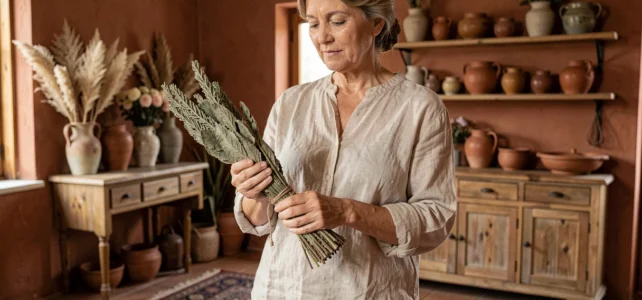
Local alternatives exist. Dried bay leaves, rosemary, or thyme, burned in the same way, produce fragrant smoke without the same supply issues. Bay leaves are an accessible and local fumigation option.

Keeping a feelings journal to adjust practices
Here’s an angle that most purification guides ignore: noting impressions before and after each ritual. This “test-and-repeat” approach allows one to identify what truly works in a given home.
A simple notebook is sufficient. Before purification, describe in a few words the perceived atmosphere (heavy, neutral, restless). After the ritual, note any changes: quality of sleep the following night, feeling upon entering the room the next day, behavior of pets if any.
- Date and time of the ritual performed
- Method used (sound, salt, fumigation, ventilation)
- Room(s) concerned
- Immediate feelings and feelings at 24 hours
After a few weeks, trends begin to emerge. Some people find that sound brings them more than fumigation, or that salt works better in the bedroom than in the living room. Adapting the ritual to one’s own feelings is more useful than following a one-size-fits-all protocol.
Decluttering and furniture placement: a concrete lever
An interior saturated with unused objects visually and physically concentrates the feeling of stagnation. Sorting, giving away, or throwing away what no longer serves a purpose frees up floor space and facilitates air circulation.
Moving a large piece of furniture, even by a few dozen centimeters, changes the dynamics of a room. It’s a gesture sometimes underestimated, but it alters how one moves and how light reaches certain areas.
A clear and well-lit space naturally reduces feelings of discomfort, without requiring any particular accessories. Combined with regular ventilation and occasional sound rituals, this work on layout forms a comprehensive and reproducible approach to maintaining the energetic quality of one’s home over time.