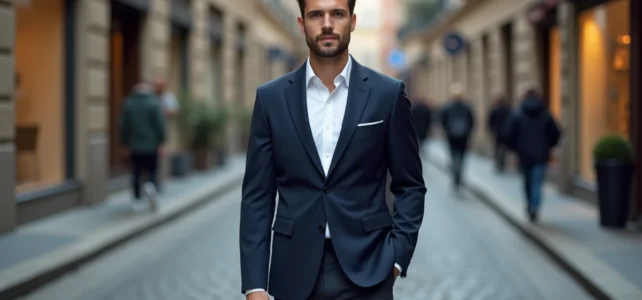
A man who opens his wardrobe in the morning and hesitates between fifteen almost identical t-shirts bought on sale accumulates without sorting. Men’s fashion in 2026 is no longer built by accumulating cheap pieces, but by reducing volume to increase quality. Modern and assertive style starts with a simple reflex: buy less, wear better.
Minimalist men’s wardrobe: five pieces that replace twenty
We start from a concrete situation. An average men’s wardrobe contains dozens of garments, many of which never leave the hanger. The first useful step is to identify the pieces that are actually worn more than twice a week.
Generally, we find the same core: a well-cut raw denim jean, a thick cotton t-shirt with a round neck, a pair of understated white sneakers, a shacket or overshirt, and a beige or khaki chino. These five pieces cover the majority of everyday situations, from casual office wear to a weekend outing in the city.
The idea is not to lock oneself into a dull uniform. It’s about laying a solid foundation on which one can add one or two strong pieces each season, without starting from scratch. A suede leather jacket in spring, a structured overcoat in autumn: we add depth without overloading.
For those who want to delve deeper into this mindset and explore concrete looks built around sustainable basics, fashion on Mr Seb offers selections focused on quality rather than volume.
Premium casual men’s wear: why well-cut basics have taken over
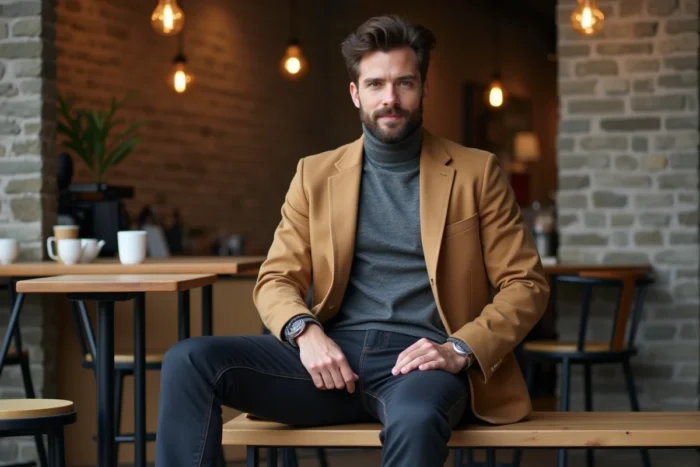
Since the end of 2025, the demand for premium casual men’s clothing has significantly increased. Consumers prefer better-cut and more durable basics over fast fashion. This movement elevates the entire casual wear segment.
A t-shirt whose collar doesn’t deform after three washes, pants that fit perfectly without alterations, a knit that remains dense enough to keep its shape: this is what defines premium casual. Cut and material matter more than brand or logo.
This anti-fast fashion shift has a direct impact on the budget. We spend the same, if not less, over the year, but we buy three pieces instead of twelve. The cost per wear drops, and style gains coherence, because we no longer dilute our wardrobe with impulsive purchases.
How to spot a basic that will last
Before buying, check a few specific points:
- The inner seams are clean and reinforced at stress points (shoulders, crotch, cuffs). A clean overlock is the first sign of a garment designed to last.
- The fabric returns to place when pulled slightly. A cotton or jersey that remains deformed after stretching won’t last ten washes.
- The cut follows the body line without being tight. You should be able to raise your arms in a jacket without the back riding up by five centimeters.
Opinions vary on this point, but generally, a garment that you hesitate to buy due to the fit will not be worn. It’s better to pass.
Men’s accessories with assertive style: the piece that changes an entire outfit
A look made up of neutral basics can quickly appear flat. This is where a well-chosen accessory makes a difference, without turning the outfit into a trend catalog.
In 2026, oversized men’s glasses with thick frames are establishing themselves as a marker of assertive style. Vintage shapes (round, oval) are making a strong comeback. A well-chosen pair of glasses is enough to give character to a white t-shirt and raw denim jeans. It’s the simplest lever to assert a minimalist look.

For watches, a simple dial on a leather or steel strap is preferred. For bags, a textured leather briefcase or a thick canvas tote bag replaces the shapeless backpack. One bold accessory is better than three discreet ones.
Common mistake: accumulating trendy accessories
We often see overloaded looks (rings, bracelets, necklaces, glasses, caps, all at once). The result muddles the message instead of asserting it. The operational rule: one strong accessory per outfit, two at most. The rest stays in the drawer.
Clothing and self-confidence: what the outfit really changes
The psychological dimension of clothing is gaining traction in discussions on social media and among image coaches. The basic idea is simple: the outfit affects mood, confidence, and how one is perceived at first glance.
In practice, we see this in everyday situations. A man wearing a garment he has chosen, that fits well, and of which he knows the quality stands differently. He doesn’t tug at his t-shirt, doesn’t pull up his pants every five minutes, doesn’t regret his purchase.
Personal branding starts with what you wear every morning. It’s not about price; it’s about coherence between what you want to project and what you put on. A well-tailored chino at a reasonable price projects more solidity than a poorly fitted suit bought on sale.
Building a modern and assertive style doesn’t require following every seasonal trend. You choose a few solid pieces, wear them often, and add an accessory that marks your personality. Fewer clothes, more coherence, and shorter mornings in front of the wardrobe.