
The choice of a thermal brush cutter relies less on the engine displacement than on the compatibility between the type of engine, the cutting system, and the targeted vegetation. We often observe machines that are oversized for regular maintenance or undersized against established brambles. This comparison focuses on the technical points that make a difference in use, beyond the product sheets.
2-stroke or 4-stroke engine: real impact on cutting and maintenance
A 2-stroke engine remains the standard for the majority of thermal brush cutters on the market. Its power-to-weight ratio is superior, resulting in a lighter machine when held at arm’s length during prolonged sessions. The gasoline-oil mixture, often perceived as a constraint, ensures direct lubrication of the piston without a separate oil circuit.
The 4-stroke (Honda UMS 425, for example) or hybrid architectures like the Stihl 4-MIX engine provide a more linear torque at low RPM. On tall and dense grasses, this consistency avoids jolts and reduces mechanical fatigue of the cutting head. Fuel consumption decreases significantly, as do emissions.
We recommend the 4-stroke or 4-MIX for large areas requiring several consecutive hours of work. For occasional interventions on rugged terrain where every gram counts, the 2-stroke retains a clear advantage. The detailed sheets available on top-debroussailleuse-thermique.com allow for a model-by-model comparison of these engine architectures.
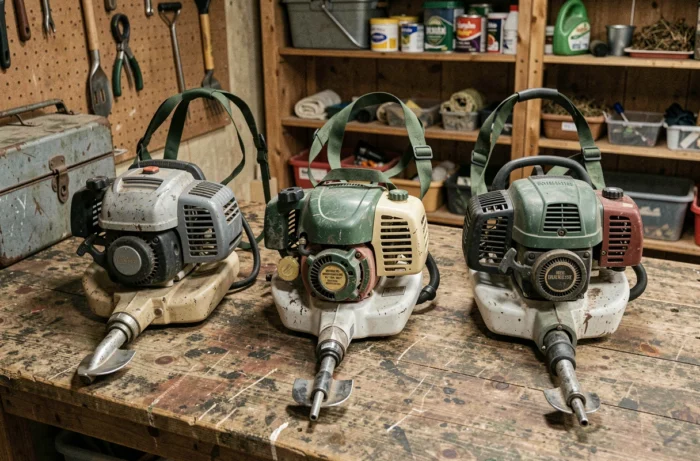
Cutting system: line, blade, or disc depending on the vegetation
The choice of cutting tool influences the result more than the engine power. A round-section nylon line is suitable for soft grass and edge finishing. As soon as the vegetation becomes woody (brambles, hazel shoots, dry ferns), the line breaks or wears out within minutes.
The three or four-tooth blade effectively tackles semi-woody undergrowth. However, it requires a clear ground free of stones and fences, as a shock against a hard obstacle can misalign the drive shaft. The grass disc, less aggressive, represents a good compromise for mixed terrains.
- Nylon line (round or square, section 2.4 to 3.3 mm): regular maintenance, soft grasses, edges, and finishing along flower beds.
- 3-tooth steel blade: brambles, young woody shoots, dense vegetation up to the size of a thumb.
- 80-tooth mulching disc: thick underbrush, shrub shoots, forest clearing work, or parcel compliance tasks.
On versatile models like the Stihl FS 131 or the Echo SRM-2621TESU, switching from one cutting tool to another is done without tools. This mechanical detail significantly speeds up work on heterogeneous terrains.
Noise constraints and regulations: a criterion that has become technical
Thermal brush cutters are subject to the noise emergence rules of the decree n°2006-1099 on neighborhood noise. The regulations set a maximum emergence of 5 dB(A) during the day (7am-10pm) and 3 dB(A) at night compared to ambient noise. Some municipalities go further: the city of Tarnos (Landes) prohibits the use of thermal brush cutting tools between 2pm and 10pm as part of fire prevention.
This local tightening pushes for the integration of noise level as a real selection criterion. A 4-stroke engine typically runs significantly quieter than a 2-stroke at equivalent power. For professionals subject to restricted time slots, this difference affects daily productivity.
Since 2025, we have observed a multiplication of municipal decrees restricting the operating hours of thermal garden equipment. Checking local regulations before purchasing a thermal brush cutter prevents ending up with a machine that can only be used for a few hours a day.
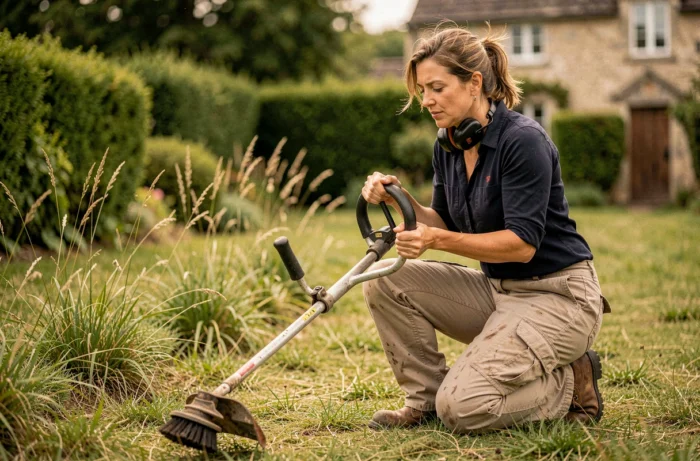
Ergonomics and harness: what separates half an hour of work from a full day
Power is useless if the operator puts down the machine after forty minutes. The dry weight of a thermal brush cutter varies significantly from model to model. During a multi-hour session, every gram contributes to muscle fatigue in the shoulders and lower back.
The type of harness makes a bigger difference than the raw weight. A simple shoulder strap is sufficient for light work. Once the duration exceeds an hour or the terrain is sloped, a double harness with back support becomes essential. Professional models from Husqvarna and Stihl offer systems with integrated vibration absorption that reduce the transmission of shocks to the pelvis.
- Simple harness: suitable for short sessions on flat terrain, often provided with entry-level models.
- Double harness with wide straps: distributes the load across both shoulders, recommended for more than an hour of continuous work.
- Professional harness with back plate: protects the spine, absorbs vibrations, essential on sloped terrains or for forestry work.
The balance of the machine also plays a role. A drive shaft that is too long relative to the user’s size shifts the center of gravity forward and strains the wrists. Models with a length-adjustable tube offer a measurable ergonomic advantage in this regard.
Fuel and mixture: a common mistake that costs dearly
On a 2-stroke engine, the gasoline-oil mixture ratio depends on the manufacturer. Using an approximate dosage accelerates wear on the piston and cylinder. Specific 2-stroke synthetic oil is preferable to universal oils, as it burns cleaner and limits spark plug fouling.
The choice of fuel itself deserves attention. SP95-E10 contains up to 10% ethanol, which can damage the hoses and seals of a thermal engine not designed for this use. Check E10 compatibility in the manufacturer’s manual before filling the tank to avoid costly repairs. Some manufacturers exclusively recommend SP98 or ready-to-use alkylate fuel.
Neglecting air filter maintenance directly affects the longevity of the engine. A clogged filter weakens the air-fuel mixture, raises internal temperature, and causes a gradual loss of power that many mistakenly attribute to normal machine wear.