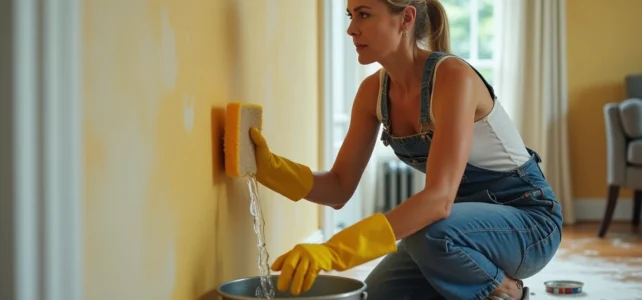
Washing a wall before painting is not always mandatory. Depending on the condition of the surface, a simple dusting may suffice, while a wall soiled by cooking grease or nicotine requires a thorough cleaning. Knowing how to distinguish these situations helps avoid wasting time on an unnecessary step, or worse, compromising the adhesion of the paint by skipping it when it was needed.
Washing or dusting: what cleaning based on the condition of the wall
Manufacturers’ recommendations have evolved in recent years. Washing with alkaline detergent is no longer systematically prescribed for a wall that is merely dusty or in good condition. A careful dusting (vacuuming followed by a microfiber cloth) effectively replaces washing when the surface shows no grease or tobacco residue.
On the other hand, a greasy or nicotine-stained wall requires a proper chemical wash. Without it, the layer of paint forms a superficial film that blisters within weeks. The table below summarizes common scenarios.
| Condition of the wall | Appropriate cleaning | Recommended product |
|---|---|---|
| Dusty, dry, healthy | Dusting only | Vacuum + microfiber |
| Grease marks (kitchen) | Targeted washing | Soda crystals or degreaser |
| Nicotine, soot | Full washing | Saint-Marc detergent or equivalent alkaline |
| Visible mold | Antifungal treatment + washing | Fungicidal solution before washing |
| Old wallpaper glue | Thorough washing | Hot water + detergent or soda crystals |
This preliminary diagnosis allows targeting effort on the areas that need it, rather than soaking the entire room. When you know how to wash a wall before painting, you quickly identify that partial washing is sufficient in most common renovations.
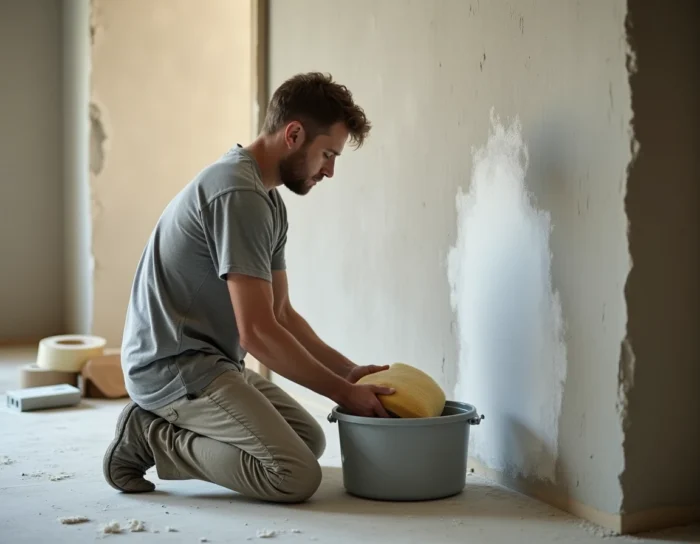
Soda crystals, Saint-Marc detergent, black soap: comparison of wall washing products
The choice of product depends on the type of dirt and the sensitivity of the surface. Saint-Marc detergent remains the historical reference, but soda crystals offer superior degreasing power at a lower cost. Black soap, on the other hand, is suitable for delicate surfaces or matte finishes that you do not want to alter.
Saint-Marc detergent
Formulated for cleaning painted walls, it dissolves in hot water. Its alkaline pH lifts grease and organic residues. It sometimes leaves a slight film that must be rinsed thoroughly to avoid adhesion problems when painting.
Soda crystals
More concentrated in alkalinity, they tackle stubborn dirt without excessive scrubbing. Wearing gloves is essential: the crystals irritate the skin with prolonged contact. They rinse easily and do not leave a residual film on the surface.
Black soap
This is the least aggressive solution. It is suitable for lightly soiled walls and fragile old paints. Black soap does not replace an alkaline degreaser on a kitchen wall saturated with greasy splashes.
- For a kitchen wall or a ceiling yellowed by smoke, prefer diluted soda crystals in hot water.
- For a bedroom or living room without greasy stains, black soap or simple dusting is sufficient.
- For walls that have received wallpaper glue, Saint-Marc detergent remains the most versatile choice.
- In all cases, wear gloves, protect the floor, and work with windows open.
Technique for washing walls without streaks: from bottom to top
The technical gesture that distinguishes a clean result from a wall streaked with drips is summed up in one rule: wash from bottom to top, rinse from top to bottom. This counterintuitive principle prevents dirty water from running down onto dry areas, where it would leave almost impossible-to-fix marks.
Specifically, you soak a wide sponge in the washing solution, wring it out enough so that water does not drip, and scrub in horizontal bands starting from the bottom of the wall. Each band overlaps the previous one by a few centimeters.
Rinsing and drying the wall before painting
The rinsing is done with clear water, this time from top to bottom, to wash away the detergent residues towards the floor. Insufficient rinsing leaves an alkaline film that prevents the paint from adhering. Two passes with a clean sponge are the minimum.
Drying is the step most often rushed. A wall that appears dry on the surface may still contain moisture in the plaster. Depending on the thickness of the surface and the ventilation of the room, drying time can vary significantly. Painting on a still damp wall causes blistering and rapid peeling.
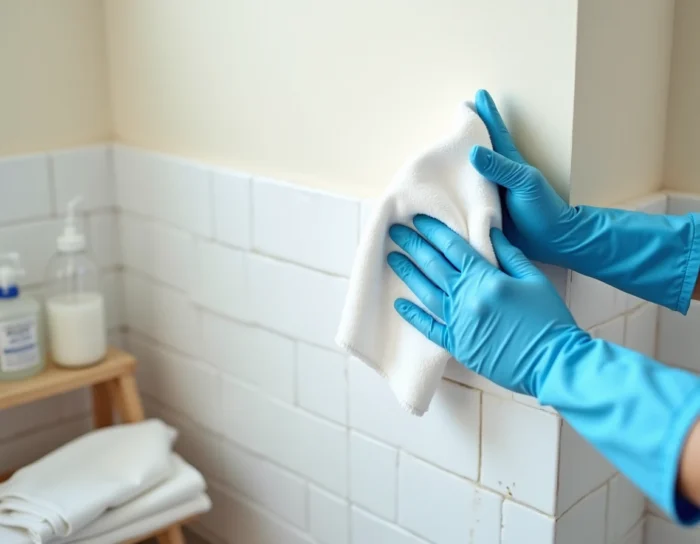
Preparing the surface after washing: filling, smoothing, and primer
Washing does not correct cracks or irregularities. Once the wall is dry, inspecting the surface reveals defects that dirt had masked: plug holes, microcracks, areas of friable plaster.
- Fill holes and cracks with a filling compound, then sand with fine sandpaper once dry.
- Apply a smoothing compound to irregular areas to achieve a flat surface.
- Apply a bonding primer if the surface is porous, absorbent, or shows residual stains after washing.
The sequence of washing, filling, smoothing, and priming determines the durability of the paint over several years. Each skipped step results in visible defects from the first coat, or in premature peeling a few months later.
The primer plays a often underestimated role: it equalizes the absorption of the surface. Without it, the areas filled with compound absorb more paint than the rest of the wall, creating noticeable color differences in low-angle light.
Washing remains one step in preparation among others, not an end in itself. A wall that is properly diagnosed, cleaned according to its actual condition, thoroughly rinsed, and correctly dried offers a reliable surface. It is the quality of this preparation, much more than the number of coats of paint, that guarantees a durable and homogeneous result.