A parent living alone misses a medical appointment because they couldn’t arrange transportation. A pill organizer remains full at the end of the week because no one checks on it. These situations are often observed even before the loss of autonomy is diagnosed. Services dedicated to seniors are evolving to address these concrete issues, well beyond simple meal delivery or traditional teleassistance.
Home Autonomy Services: What the Reform Changes for Seniors
Until recently, home assistance for the elderly was fragmented among several organizations with opaque acronyms: SAAD for daily assistance, SSIAD for nursing care, SPASAD for mixed cases. These blocks are now merging into Home Autonomy Services (SAD), a unified model that concretely changes the organization on the ground.
In practice, this means that a single point of contact can coordinate assistance with getting up, personal hygiene, visits from a nurse, and medication management. We are moving from a system where families had to juggle between multiple providers to a centralized pathway. For caregivers, this is a tangible change: fewer calls, less duplication, fewer missed appointments between two services that did not communicate.
This consolidation is complemented by the creation of the Departmental Public Service for Autonomy (SPDA), stemming from the “Aging Well” law. Its role is to simplify the orientation of people experiencing loss of autonomy and their relatives. Instead of searching for the right counter, one can explore the services offered by actuseniors.net to quickly identify available resources based on geographic location and level of need.
Senior Pathway Coordination: The True Lever of Autonomy
Technology grabs attention (connected bracelets, fall sensors, teleconsultation), but the number one issue reported by families is not technical. It’s coordination. Who informs the primary care physician when home assistance notices a change in behavior? Who adjusts the care plan when a temporary hospitalization disrupts the schedule?
The most useful innovative services are those that ensure continuity of care, not those that add another gadget. Coordination platforms, often linked to SAD structures, now allow sharing a digital liaison notebook between home assistance, private nurses, and family members. Each participant notes their observations, and an alert is raised if something unusual occurs.
This type of hybrid service also addresses a structural constraint in the sector: the persistent shortage of staff. When there are not enough hands, coordinating existing interventions yields better results than adding new ones. A well-synchronized caregiver visit with meal delivery and medication reminders meets more needs than a disorganized schedule with twice as many hours.
What Coordination Changes in Daily Life
- The primary care physician receives a weekly report of observations from home assistance, without the family acting as a telephone relay.
- Schedule changes (absence of a caregiver, time modification) are transmitted in real-time via an application accessible to relatives.
- Alert signals (loss of appetite, confusion, minor falls) are tracked in a shared history, allowing the geriatrician to identify gradual deterioration during the next consultation.
Home Automation and Sensors for Seniors: Distinguishing Gadgets from Useful Tools
Today, there are dozens of connected devices targeting the elderly: watches with fall detection, smart floors, pill organizers with light reminders. Not all have the same utility value. Feedback varies greatly depending on the individual’s profile and their familiarity with technology.
What works best, according to field feedback, are passive devices, those that require no action from the senior. A motion sensor placed in the hallway detects abnormal inactivity and alerts a relative. A connected smoke detector directly notifies the teleassistance service. These solutions require neither daily recharging nor screen manipulation.
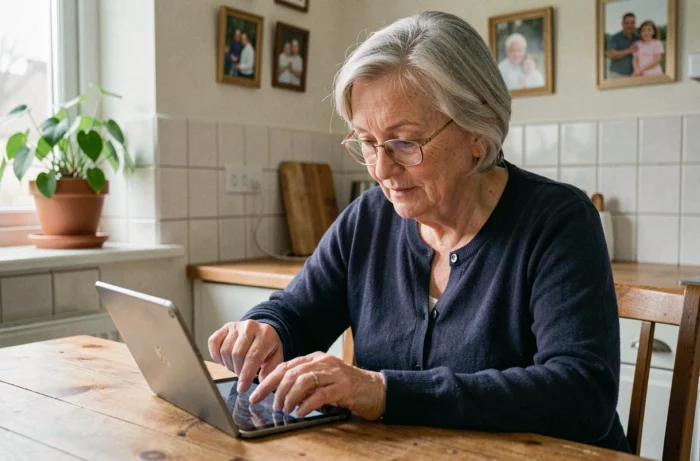
On the other hand, active devices (simplified tablets, cognitive stimulation apps, alert-button bracelets) require learning and monitoring. They work well when a caregiver or professional supports their implementation and regularly checks that the tool is being used.
Criteria for Evaluating a Home Automation Device
- Energy autonomy: a sensor that needs recharging every two days will be abandoned in a few weeks.
- Discretion: seniors are more accepting of a device integrated into furniture than a bracelet that signals their fragility.
- Interoperability: the sensor must be able to communicate with the coordination platform used by home caregivers, not operate in isolation with its own application.
- Absence of false positives: a system that triggers three unjustified alerts per week will be disabled by the family after a month.
Maintaining Social Connections: Services that Reduce Senior Isolation
Isolation remains a major aggravating factor in the loss of autonomy. Innovative services in this area go beyond family video conferences. Regular visits by trained volunteers, coordinated through digital platforms that enable stable pairings between a visitor and a senior, are emerging.
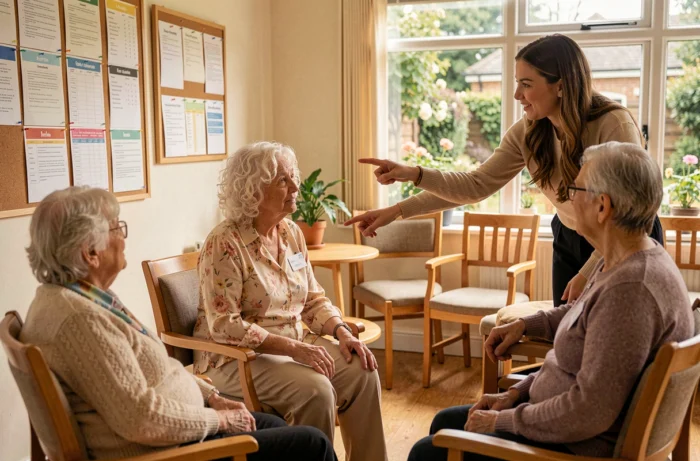
Some assisted living residences offer collective activities open to neighborhood seniors who still live at home. This mixed model, between living at home and accessing the resources of a residence, provides a social safety net without imposing a move. Activities range from gentle gymnastics to digital workshops, including shared meals.
The social dimension is also where the silver economy invests the most. Platforms connecting seniors with shared interests are multiplying, featuring geolocation functionalities to facilitate local meetings.
The common thread among all these services, whether technological, organizational, or human, remains the same: their effectiveness depends on the regularity and quality of follow-up. A brilliant sensor without anyone to read its data, or a visiting program without coordination, changes nothing in daily life. It is the combination of reliable tools and a solid human organization that allows seniors to remain at home under good conditions.