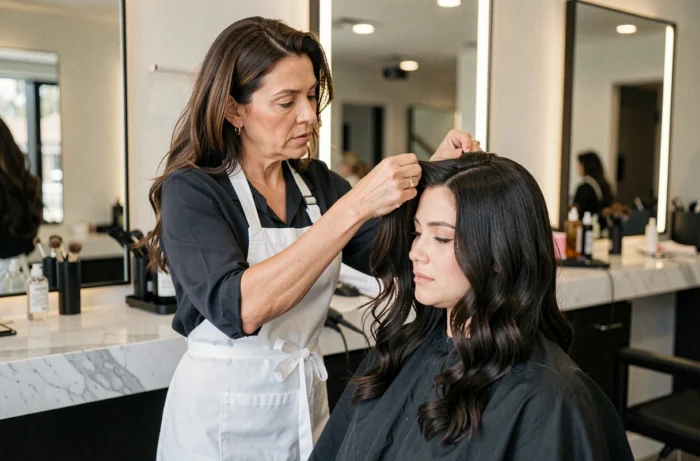
The morphology of the face is based on a ratio between three measurements: the width of the forehead, the width of the cheekbones, and that of the jaw, compared to the total length of the face. This ratio determines a dominant geometric shape (oval, round, square, heart, elongated, diamond). Adapting your hairstyle to this shape involves visually rebalancing these proportions through volume, length, and placement of the strands.
Face Measurement Method: Forehead, Jaw, and Proportions
Before looking for a haircut, the first step is to accurately determine your own shape. Most hairstyle errors come from approximate self-assessment. Many people declare themselves to have a “round face” when their proportions correspond to an oval or diamond.
To obtain a reliable result, stand in front of a mirror under uniform lighting, with hair pulled back and no makeup. Two mirrors can also help check the profile. Direct light and the absence of filters improve the accuracy of the analysis, whether you do it yourself or through a digital tool.
Measure or visually estimate four distances:
- The width of the forehead, from one temple to the other, at the widest point.
- The width of the cheekbones, on the horizontal line passing through the tops of the ears.
- The width of the jaw, between the mandibular angles, just below the ears.
- The length of the face, from the top of the forehead (hairline) to the bottom of the chin.
If the length significantly exceeds the width and the forehead and jaw are close in dimension, the face is elongated. If the cheekbones dominate and the chin narrows, it leans towards a diamond or heart shape. It is this comparative reading that matters, not an isolated shape.
It is also possible to choose your hairstyle with Kabanes by following a guided method that details each step of the morphological analysis.

Volume and Layers: The Two Levers That Rebalance a Face
Articles on face shaping often list cuts by face shape, but the underlying mechanism is always the same: volume compensates for the narrowest area, and layers reduce the widest area. Understanding this principle avoids memorizing dozens of combinations.
Volume as a Correction Tool
An elongated face appears shorter if volume is created on the sides, at the level of the cheekbones. A round face, on the other hand, benefits from volume above the crown to elongate the silhouette.
For a square face, volume placed above the jaw (at the temples and the top of the head) softens the angularity of the features. Lateral volume at the jawline would reinforce the square appearance, making it a common trap.
Layers as a Structural Tool
Long layers lighten the sides without removing length. On a round face, layers that start from the cheekbone down refine the outline and avoid the “helmet” effect of straight mid-length cuts.
On a heart-shaped face (wide forehead, narrow chin), inverted layers – shorter on top, fuller towards the jaw – rebalance the lower third. The curtain bangs, very open on the sides, reduce the apparent width of the forehead without flattening it.
Bangs and Parting: Two Details That Change the Perception of the Forehead
Bangs and parting modify the visible proportion of the forehead, which directly impacts the perception of the overall shape.
A straight, thick fringe visually shortens the face. It suits elongated faces but weighs down a round face. A tapered or side fringe reduces the forehead without cutting the face in half, making it adaptable to most shapes.
A middle part accentuates symmetry. On an oval face, this works well as the proportions are already balanced. On a square face, the central part emphasizes the width of the jaw. An off-center part creates asymmetry that breaks the horizontal line and softens the angles.

Hair Texture and Thickness: Often Ignored Variables
The shape of the face is only part of the equation. Classic face shaping recommendations assume medium-density hair with neutral movement. In practice, texture and thickness modify the final result as much as the cut itself.
Thick, wavy hair naturally produces lateral volume. On a round face, this natural tendency complicates the goal of elongation. The layers should then be more pronounced on the sides, and the length worn below the shoulders to pull the silhouette down.
Fine, straight hair lacks volume at the crown. For a square face, where height volume is desirable, techniques like root-lifting drying or a textured short cut on top compensate for this lack.
The ideal cut combines face shape, hair texture, and styling habits. A technically perfect cut for a diamond face will not work if it requires a daily blow-dry that the person will never do. Recent virtual try-on tools increasingly incorporate these parameters but remain reliable mainly for silhouette, length, and bangs, less so for actual volume and movement over the days.
Choosing a hairstyle suited to the morphology of the face is based on a simple principle – compensating for disproportions with volume and layers – but its application depends on the actual hair, not a theoretical model. Measuring your face correctly remains the first step, and the most often rushed.