
Giving a cactus as a gift raises a rarely asked question: what exactly do we measure when we compare its symbolism to that of cut flowers or traditional houseplants? Between the lifespan of the plant, the emotional register perceived by the recipient, and the cultural anchoring of the gesture, the parameters vary much more than one might think.
The cactus is neither a bouquet of roses nor a ficus, and its meaning oscillates between lasting love, protection, and identity recognition depending on the context in which it is given.
Cactus, flower bouquet, houseplant: a comparative table of symbolisms
To place the cactus within the landscape of plant gifts, one must first compare the symbolic registers associated with each type of present. The differences are clear.
| Criterion | Cut flower bouquet | Traditional houseplant | Cactus |
|---|---|---|---|
| Lifespan | Several days to two weeks | Several years with regular care | Several years, minimal care |
| Dominant symbolism | Passionate love, seduction, celebration | Vitality, purification, well-being | Resilience, protection, lasting love |
| Emotional register | Ephemeral, intense | Everyday, soothing | Deep, discreet, enduring |
| Care required | Change the water, cut the stems | Regular watering, appropriate light | Rare watering, direct light |
| Perception of “original gift” | Classic, expected | Common | Offbeat, memorable |
The red bouquet remains the universal language of passion. In contrast, the cactus conveys a message that ephemeral flowers cannot carry: a love that withstands difficult conditions.
This distinction explains why the gesture of giving a cactus meaning and love takes on a particular dimension in long-term relationships, old friendships, or family ties.
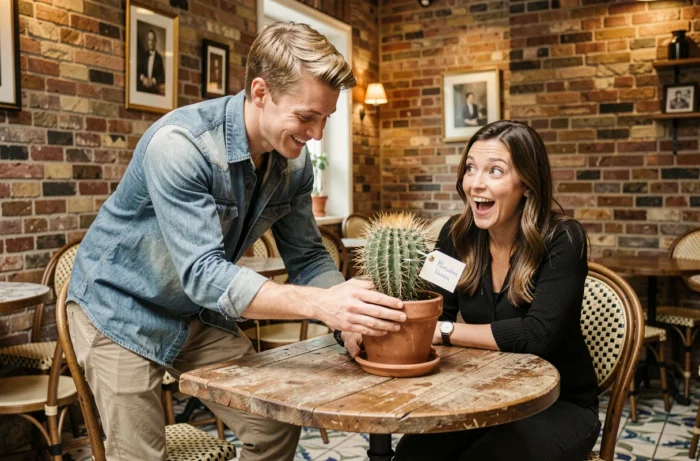
Cactus symbolism according to cultural context
The meaning of a cactus given as a gift changes radically depending on the cultural background of the recipient. This is a parameter that most “original gift” guides overlook.
Native American traditions and unconditional love
In Native American culture, the cactus represents warmth and unconditional love. Its ability to survive in arid environments makes it a symbol of emotional perseverance. Giving a cactus in this context is to acknowledge the inner strength of the other.
Identity dimension in Mexico
Giving a cactus to someone attached to Mexican culture can be interpreted as a sign of recognition of their roots and resilience. The cactus appears on the national flag and runs through the visual history of the country. This gesture then transcends the decorative register to touch on a strong identity and emotional dimension.
Eastern cultures and protection
In some East Asian traditions, the cactus symbolizes protection. Its thorns are believed to ward off negative energies. Giving a cactus is akin to wishing that the recipient be protected, an intention far removed from the common notion that the thorns represent distance or rejection.
These cultural differences show that the same cactus carries opposing messages depending on who receives it. Before giving, it is useful to consider which symbolic register will resonate with the recipient.
Christmas cactus and ceremonies: an unknown love symbolism
Not all cacti convey the same symbolic weight. The Schlumbergera, commonly known as the Christmas cactus, occupies a special place.
Unlike desert cacti associated with endurance, the Christmas cactus blooms in winter, when most plants are dormant. This winter blooming gives it a symbolism of love that persists in dark times.
This cactus is found in certain ceremonies, where it represents lasting family ties and love shared across generations. A mother giving a Christmas cactus to her daughter conveys a different message than a friend giving an Echinocactus: the former speaks of lineage, while the latter speaks of courage.
- The Christmas cactus (Schlumbergera) refers to family love, transmission, and shared celebrations
- The mother-in-law’s cushion cactus (Echinocactus grusonii) evokes protection, sometimes tinged with humor
- The candle cactus symbolizes endurance and verticality in the face of challenges
- Small cacti in composition, often given among friends, play on the decorative register and light affection
The choice of variety thus constitutes a first level of language, even before the written message on the card.
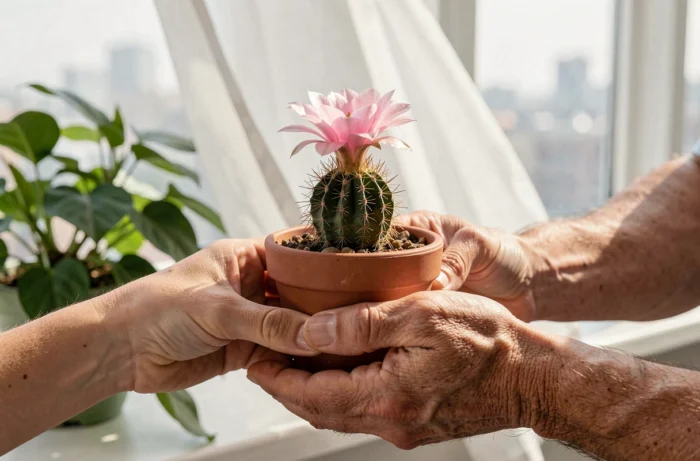
Cactus gift in 2026: an established classic, no longer a trendy gadget
The “cactus craze” observed between 2016 and 2020 has gradually subsided. The return of tropical foliage, hanging plants, and dried bouquets has redistributed attention. The cactus remains present, but it has transitioned from a trendy gadget to a contemporary classic.
This shift changes the perception of the gift. A cactus given in 2017 could be seen as a nod to an Instagram trend. The same gesture in 2026 is part of a more thoughtful approach, that of a sustainable plant gift in a context of responsible consumption.
The minimal care of the cactus also plays a role. For a recipient who travels, lives in an apartment, or lacks a green thumb, the cactus remains the only living gift that does not generate guilt. No need to entrust it to a neighbor during vacation.
However, giving a cactus without considering the variety or the container reduces the gesture to a default purchase. The pot, the size of the specimen, and the accompanying card transform a decorative object into a personal message. A cactus in a carefully chosen cache-pot does not convey the same message as a mini cactus in plastic bought at the supermarket checkout.
The cactus remains a gift whose meaning is constructed as much by the giver’s choice as by the recipient’s interpretation. Its symbolism of love, protection, or resilience is fully activated only when the cultural context, variety, and intention are aligned. It is a gift that requires little maintenance but much discernment.