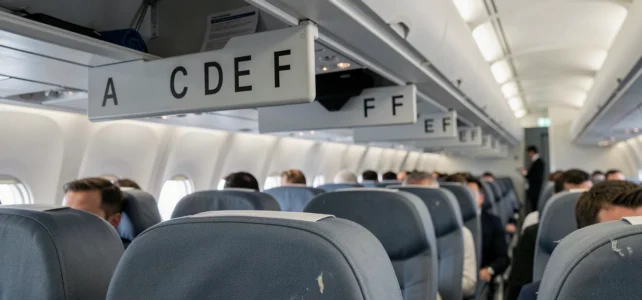
The letter B is missing from the cabin layout of several commercial aircraft. This observation surprises passengers accustomed to a logical alphabetical sequence (A, B, C, D, etc.). The explanation is less about an oversight and more about a technical convention related to the width of the fuselage and the number of seats per row.
Fuselage Width and Seat Lettering: What Cabin Geometry Imposes
The presence or absence of a letter in the cabin layout directly depends on the number of seats per block. On a classic single-aisle aircraft in a 3-3 configuration, each block has three seats: A (window), B (middle), C (aisle) on one side, and D (aisle), E (middle), F (window) on the other. In this case, the letter B exists.
On an aircraft with a narrower cabin, such as the Airbus A220-300 operated by Air Canada, the layout changes to 2-3 configuration. The block of two seats has no middle seat. The letter B disappears because there is physically no seat to assign it to.
The logic is the same on wide-body aircraft. A block of two seats in business class on a Boeing 777 skips the letter B to maintain consistency: A designates the window, C the aisle. This consistency allows the passenger to know, regardless of the aircraft, that the reason there is no seat B on an airplane is due to the absence of a middle seat in a given block.
Comparison of Cabin Configurations by Aircraft Type
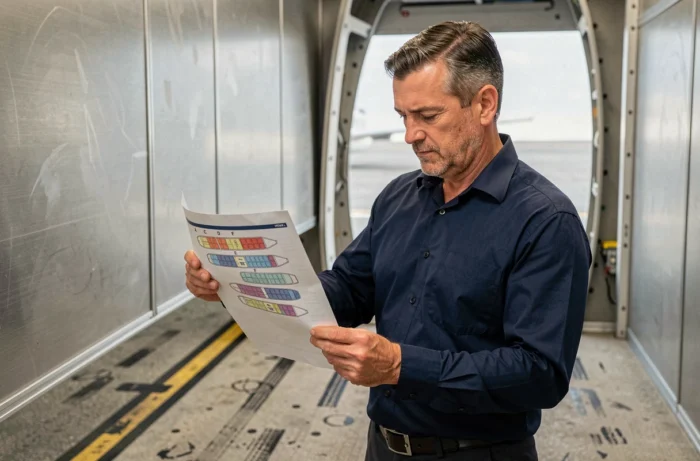
The table below illustrates how the letter B appears or disappears depending on the seating arrangement in several common models.
| Aircraft | Economy Configuration | Left Lettering | Right Lettering | Seat B Present |
|---|---|---|---|---|
| Airbus A320 (3-3) | 3 + 3 | A, B, C | D, E, F | Yes |
| Airbus A220-300 (2-3) | 2 + 3 | A, C | D, E, F | No |
| Boeing 777 (3-3-3) | 3 + 3 + 3 | A, B, C | D, E, F + G, H, J | Yes |
| Boeing 777 (business class 1-2-1) | 1 + 2 + 1 | A | D, F + K | No |
| Boeing 737-800 (3-3) | 3 + 3 | A, B, C | D, E, F | Yes |
The common point in cases without a seat B is simple: a block of two seats or fewer eliminates the middle seat. The letter B, reserved for this position, then has no reason to exist in the cabin layout.
IATA Lettering Convention and Consistency Among Airlines
The seat lettering system relies on a convention shared by airlines and reservation systems. The goal is to ensure that the letter A always corresponds to a left window and that C always corresponds to an aisle, regardless of the aircraft.
If airlines reassigned letters in a continuous sequence (A, B for a block of two), a passenger reserving a seat B would expect a middle seat and would end up by the aisle. The stability of the lettering avoids placement errors during boarding and reduces crew interventions.
This convention also explains other absences. The letter I is generally excluded to avoid confusion with the number 1. On wide-body aircraft in a wide configuration, the sequence can go up to K, skipping I.
- A and F (or K on wide bodies) systematically designate the windows
- C and D (or G depending on the configuration) designate the aisles
- B and E designate the middle seats, present only in blocks of three seats or more
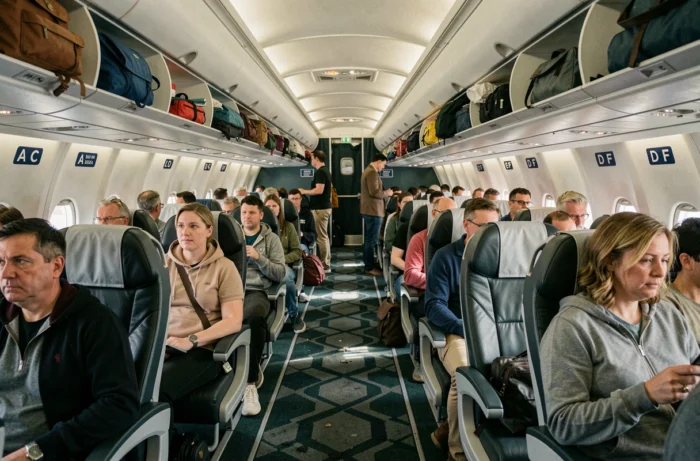
Cabin Reconfiguration: When Seat B Reappears or Disappears
The absence of seat B is not etched into the structure of the aircraft. The same airframe can see the letter B appear or disappear after reconfiguration. Some airlines, like Asiana, have modified the cabin layout of certain aircraft by changing the seat density. A layout without B in one section may have been replaced by a layout including B when the row logic changed from a block of two to a block of three.
In 2026, the trend observed among several carriers is to review cabin density. Cathay Pacific has removed seats from its Airbus A321neo to improve space in economy class. This type of decision alters the configuration per row and can, consequently, affect the lettering.
- WestJet has removed its least legroom seats on certain aircraft
- Cathay Pacific has reduced the number of economy seats on its A321neo to increase comfort
- Air Canada operates the A220-300 in 2-3, which structurally eliminates seat B on the left block
These adjustments show that the seat lettering is a direct consequence of the cabin density chosen by the airline, not a fixed property of the aircraft.
Seat Lettering and Online Reservation Systems
Reservation platforms display the cabin layout as declared by the airline. When a passenger selects their seat on an airline’s website, the system hides the letter B if it does not correspond to any physical seat. No empty space is displayed in its place.
This transparency varies depending on the tools. Some flight aggregators display a generic plan that does not always reflect the exact configuration of the aircraft scheduled for a given flight. Checking the cabin layout directly on the airline’s website remains the most reliable way to know if a seat B exists on a specific flight.
The missing letter in the cabin layout is therefore neither a defect nor a mystery. It reflects a simple design rule: each letter corresponds to a physical position (window, middle, aisle), and when this position does not exist, the letter disappears with it.