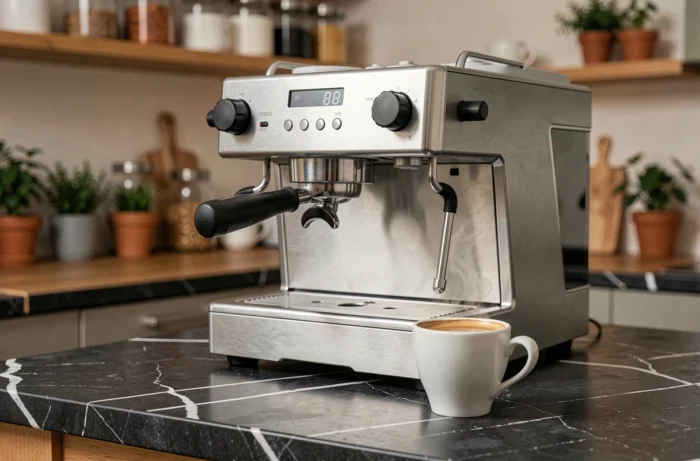
Choosing an espresso machine for home use involves balancing three rarely aligned variables: extraction quality, the time you are willing to spend each morning, and the overall budget over several years. This article compares the major families of machines based on these measurable criteria, incorporating European regulatory constraints that most guides overlook.
Extraction Pressure and European Regulations: Two Technical Benchmarks to Know
The first instinct in-store is to compare the pressure displayed on the packaging. Many manufacturers highlight values of 15 or 20 bars. This figure describes the maximum capacity of the pump, not the actual pressure at the coffee level.
The professional reference, reiterated by the Istituto Nazionale Espresso Italiano and cited by LeBonTri in August 2026, remains 9 bars at the entrance of the extraction group. Beyond this, overpressure does not improve the result in the cup. It can even cause over-extraction, making the coffee bitter.
A second technical point concerns energy consumption. European ecodesign regulations require automatic shutdown after 30 minutes of inactivity for espresso machines, bean machines, and capsule systems. If your device stays on all morning without producing coffee, it must turn off its heating by itself.
European requirements also set a ceiling of 2.00 W for network standby. This threshold directly concerns connected machines equipped with remote programming functions or smart standby. Checking the device’s compliance with these standards helps eliminate poorly designed models or those imported outside the European framework. The specifications available on machineaexpresso.fr often detail these technical characteristics for each model.
Comparison Table of Espresso Machine Types
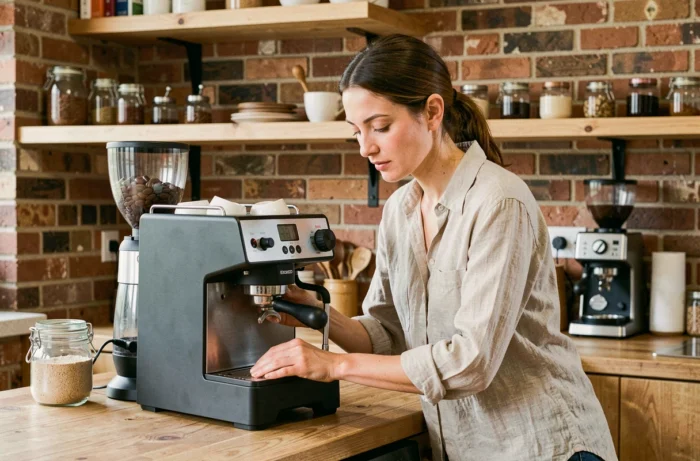
The choice is structured around four families. The table below summarizes their differences based on the criteria that weigh the most in daily use.
| Type of Machine | Purchase Cost | Cost per Cup | Preparation Time | Extraction Control |
|---|---|---|---|---|
| Capsules | Low | High | Less than one minute | None |
| Soft Pods | Low | Moderate | Less than one minute | Very limited |
| Integrated Grinder (automatic) | High | Low | One to two minutes | Configurable (grind, volume, temperature) |
| Portafilter (manual or semi-auto) | Moderate to high | Low | Two to five minutes (with separate grinder) | Total |
Reading this table reveals a common paradox: the cheapest machines to buy (capsules) are the most expensive over time. Conversely, a bean grinder pays for itself in a few months for a household consuming several coffees a day.
Grinding and Freshness of the Bean: The Factor That the Machine Alone Cannot Solve
The type of machine determines the extraction method, but the quality of the coffee in the cup primarily depends on the grind. A bean ground several weeks ago has lost most of its volatile aromatic compounds, regardless of the sophistication of the device.
- An integrated grinder machine grinds coffee on demand, ensuring appropriate freshness without additional handling.
- A portafilter machine offers total control over grind fineness but requires a separate grinder, the cost of which adds to the initial budget.
- Capsules and pods contain pre-ground coffee in a protective atmosphere, a compromise that preserves some aromas at the cost of reduced choice freedom.
The grind size directly influences the contact time between water and coffee. A grind that is too fine slows down the flow and produces bitterness, while a grind that is too coarse allows water to pass through too quickly and results in a watery outcome. On an automatic machine, the adjustment is made via a dial or menu. On a portafilter, it is up to the external grinder to provide the right grind size.
Espresso Machine with Steam Wand: An Often Underrated Criterion
If you regularly prepare cappuccinos or lattes, the steam wand becomes a crucial selection criterion. Not all wands are created equal.
Capsule machines sometimes offer an integrated milk frother, but it often works by drawing air into a reservoir, producing thick and poorly textured foam. High-end grinder machines and portafilters have a rotatable steam wand with real pressure, capable of producing silky microfoam suitable for latte art.
The presence of a steam wand has a consequence on maintenance: the milk circuit must be rinsed after each use. On automatic machines, a dedicated cleaning cycle is generally activated with a simple press. On a portafilter, cleaning is manual, quick but non-negotiable to avoid residues.
What Maintenance to Extend the Lifespan of an Espresso Machine
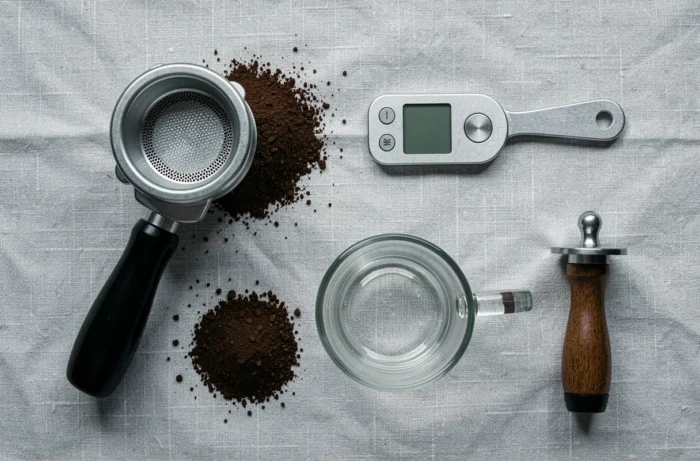
Descaling remains the most crucial operation. The frequency depends on the hardness of the water in your area. Very hard water may require descaling every three to four weeks on a machine used daily.
- Grinder machines signal the need for descaling with a light or notification, making it easier to keep track.
- Portafilters require manual attention: backflushing the extraction group, cleaning the seals, regular purging.
- Capsule machines require minimal maintenance, but the used capsule bin and water tank must be emptied and rinsed frequently to avoid mold.
Regular maintenance preserves aromas and the longevity of the device. Neglecting descaling reduces flow, alters extraction temperature, and ultimately damages the pump.
Choosing an espresso machine boils down to a clear trade-off between practicality, cumulative cost, and taste requirements. The comparison table shows that profitability leans heavily towards bean machines for regular consumers. The actual extraction pressure, the quality of the grind, and compliance with European ecodesign standards are the three most reliable technical benchmarks for distinguishing between two comparably priced models.