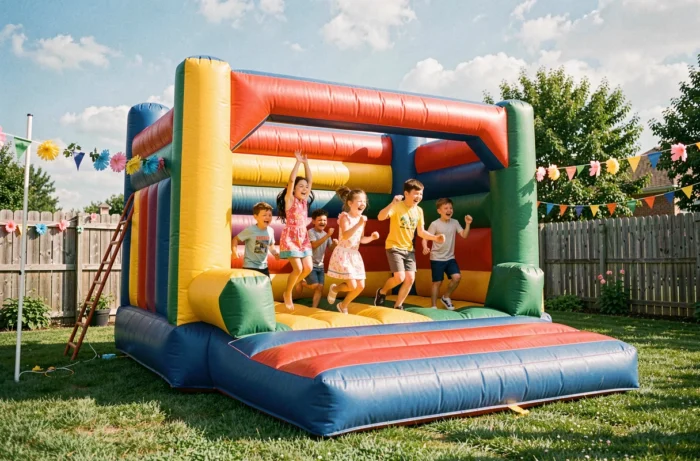
The choice of an inflatable structure for a festive event is not limited to a question of theme or color. Regulatory compliance, material strength, and suitability for the intended use profile determine both the safety of participants and the success of the entertainment. Here we detail the technical criteria that most general public guides overlook.
Regulatory Compliance of Inflatable Structures in 2025
The decree of July 25, 2022, concerning temporary and removable structures, was amended by a decree on May 13, 2025, effective from June 12, 2025. This update reinforces the requirement for a device suitable for the intended use and installed by competent persons. The central criterion is no longer just dimensional: it must be possible to justify that the installation and operation occur under normal safety conditions.
In practical terms, this means that the renter or organizer must verify the sufficient strength of the equipment relative to the expected load capacity and document the assembly conditions. A structure placed on sloping ground or exposed to unanticipated lateral wind does not meet this obligation, even if it is certified on paper.
We recommend systematically requesting a certificate of compliance from the provider mentioning the reference to the amended decree. A renter who is not familiar with this updated text deserves closer scrutiny of their practices.
Weight and Welding: What Manufacturing Quality Reveals
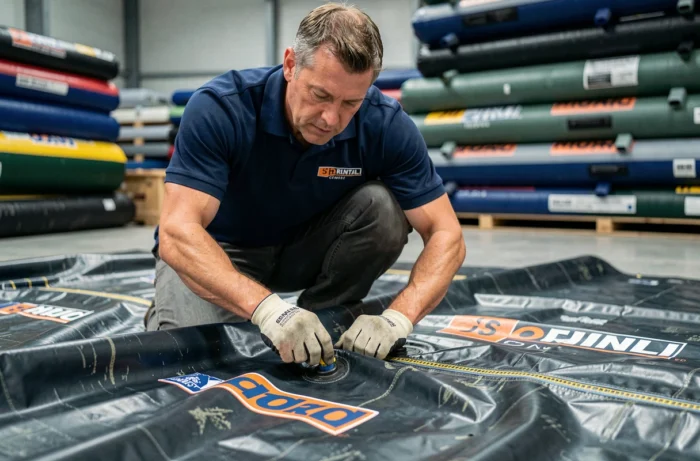
Among Diboo’s rental solutions, there are structures whose manufacturing quality directly affects their lifespan and safety. Two technical parameters deserve particular attention: the weight of the PVC fabric and the type of welding.
A fabric with a sufficiently dense weight is more resistant to repeated friction, UV rays, and micro-perforations. Entry-level structures often use lighter PVC, acceptable for occasional indoor use but unsuitable for regular outdoor operation.
High-frequency welds offer significantly greater strength than hot gluing. On an inflatable castle used by several dozen children in a day, the difference is evident at the junctions between panels, which undergo significant mechanical stress. Visually check the condition of the welds before each use: an early sign of peeling indicates a risk of tearing under load.
Sizing and Anchoring According to the Installation Ground
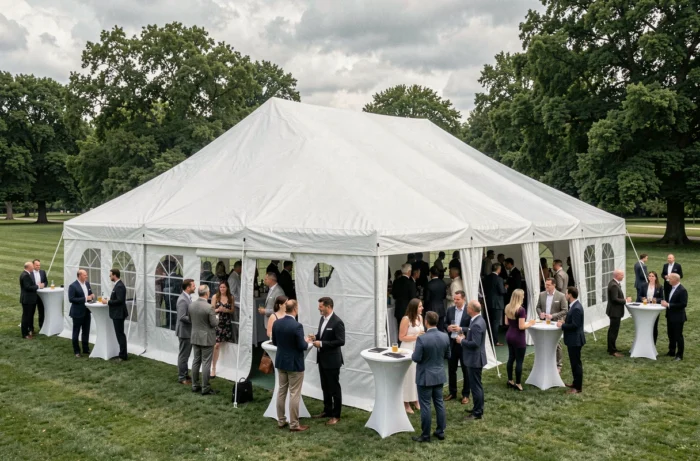
The ground area announced by the manufacturer is not sufficient to determine the actual space needed. A peripheral safety zone (generally at least one meter on each side) must be added, and height clearance must be considered, especially under a marquee or in a hall.
Soft Ground or Hard Ground: Two Distinct Anchoring Logics
On grass or soil, anchoring with deeply driven metal stakes remains the most reliable method. On asphalt, concrete, or tiles, it is necessary to use weights (sandbags, concrete blocks) whose total weight must be proportional to the wind resistance of the structure.
- On soft ground, stakes of appropriate length driven at each anchoring point specified by the manufacturer, supplemented by intermediate pegs if the ground is sandy
- On hard ground, sufficiently heavy weights at each anchoring point, connected by tension straps, never simply placed at the base of the structure
- In case of wind exceeding the thresholds indicated in the manufacturer’s instructions, operation must be suspended, regardless of the type of anchoring
We regularly observe installations where the weights are undersized. An inflatable that lifts, even partially, poses an immediate danger to users and those nearby.
Electrical Supply and Blower
Each inflatable structure requires a blower operating continuously for the entire duration of use. The motor’s power must match the volume of the structure. An undersized motor leads to insufficient inflation, a soft fabric, and an increased risk of falls for children.
Check for the availability of an electrical supply nearby and plan for an appropriately sized extension cord. A cord that is too thin over a long distance causes a voltage drop that reduces airflow.
Adapting the Inflatable Structure to User Profiles
The choice between a classic inflatable castle, an obstacle course, or a slide is not solely based on aesthetic preference. The age group of the users determines the type of suitable structure.
For children under six years old, low structures with high side walls and secure access limit the risk of falls. Inflatable courses with high obstacles are suitable for older children who can coordinate their movements.
- Under six years: closed inflatable castles, limited bounce height, access via a gentle ramp
- Six to twelve years: obstacle courses, slides with landing zones, inflatable sports games
- Teenagers and adults: giant course-type structures or sports animation games, designed to support a higher load per user
Mixing very different age groups on the same structure is the main source of accidents. A teenager jumping next to a four-year-old creates a catapult effect that can launch the younger child out of the play area.
Insurance and Organizer Responsibility
The event organizer remains legally responsible for the safety of participants, even when using an external provider. Taking out liability insurance specifically covering inflatable games is a precaution not to be overlooked.
Request a copy of the provider’s professional insurance certificate and verify that it adequately covers the type of structure and intended use. A provider offering rental without support or safety documentation effectively transfers the entire risk to the organizer.
The French regulatory framework is evolving towards increased accountability throughout the chain, from manufacturer to operator. Choosing an inflatable structure solely based on price neglects a parameter that, in the event of an incident, will weigh much more heavily than the savings made.