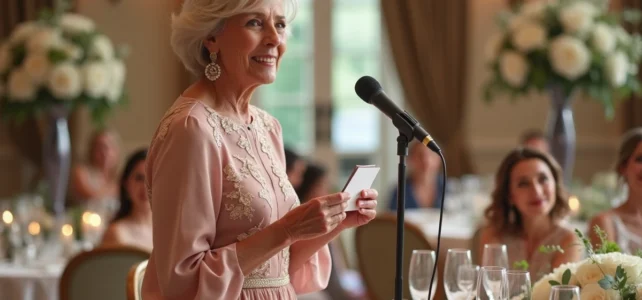
The groom’s mother’s speech refers to the moment, typically during the meal or the secular ceremony, when the mother addresses her son and the couple in front of the assembly. This moment holds a special place in the flow of a wedding: it is neither a classic toast nor a witness testimony, but a parental word that carries a particular emotional weight for both the guests and the newlyweds.
Duration and density of the groom’s mother’s speech
Ceremony guides generally recommend a duration of between two and four minutes for parental speeches. This time frame tends to tighten in recent weddings, where couples prefer short and calibrated speeches rather than lengthy addresses.
This compression of speaking time changes the game for the groom’s mother. With fewer minutes available, every sentence must carry a precise message. A dense and prepared speech makes a stronger impact than a ten-minute improvisation that drags on. The time constraint forces the selection of one or two anecdotes, a unique thread, and the elimination of anything that is filler.
Preparing the groom’s mother’s speech to her son in advance, with a written and proofread text, allows for maintaining this short format without sacrificing emotion. Reading a written text is nothing to be ashamed of: it often ensures that one does not lose the thread due to nerves.
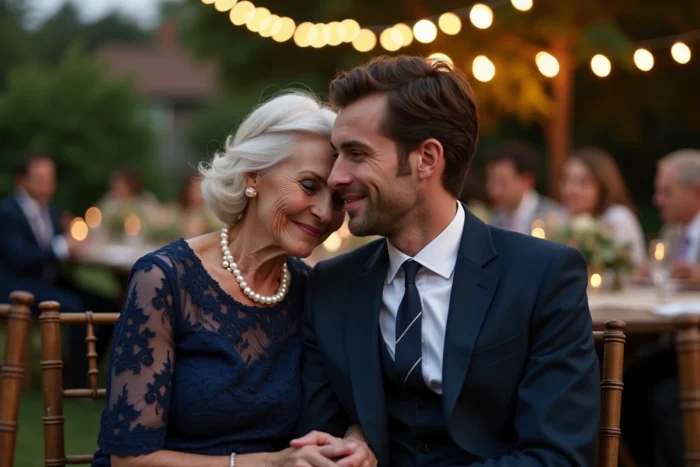
Validation of the speech by the couple before the big day
A growing practice is to have the speech reviewed by the couple before the ceremony. This prior validation is not a whim of control: it protects everyone.
Some childhood anecdotes, perfectly innocent from the mother’s perspective, may make the groom uncomfortable in front of his in-laws. A reference to an ex, a remark about the groom’s character during adolescence, or a joke about a sensitive topic can create lasting discomfort. Online testimonials recount weddings where a parent’s speech caused visible embarrassment for the couple and the guests.
Having the text reviewed reduces the risk of a misstep without taking away spontaneity. The mother retains her voice, tone, and words. The couple simply checks that no part will offend anyone in the assembly.
What the proofreading allows you to spot
- Anecdotes that seem funny in the family but lose their context in front of strangers (colleagues, friends of the couple, distant in-laws)
- References to topics the couple prefers not to address publicly (past difficulties, family tensions, previous romantic history)
- Lengthy passages: a section that works in writing may seem endless when spoken, especially after several other speeches
- The overall tone, to ensure it matches the atmosphere desired by the couple (intimate secular ceremony, festive reception, formal wedding)
Concrete structure of a successful groom’s mother’s speech
An effective speech follows a simple thread: an opening that captures attention, a body centered on a strong idea, and a closing directed towards the couple. The structure does not need to be complex to touch the audience.
The opening: setting the stage in a few sentences
Starting with a brief self-introduction is sufficient. Not everyone in the room knows the groom’s mother. A contextual sentence (“For those who don’t know me, I am the mother of…”) anchors the speech and relaxes the atmosphere.
Avoid generic quotes about love as an opening. A short and personal anecdote grabs attention better than a quote from Rumi or Saint-Exupéry that guests have already heard at three previous weddings.
The body: an anecdote, a character trait
A common pitfall is trying to summarize the groom’s entire life. It is better to choose a single memory that reveals a character trait, then show how that trait manifests in the couple’s life. This approach adds depth without lengthening the speech.
The part concerning the daughter-in-law or son-in-law deserves particular attention. Welcoming the partner with sincere and specific words (not just a simple “welcome to the family”) shows that the mother has observed the couple and appreciates the person for who they are, not just for the role they occupy.
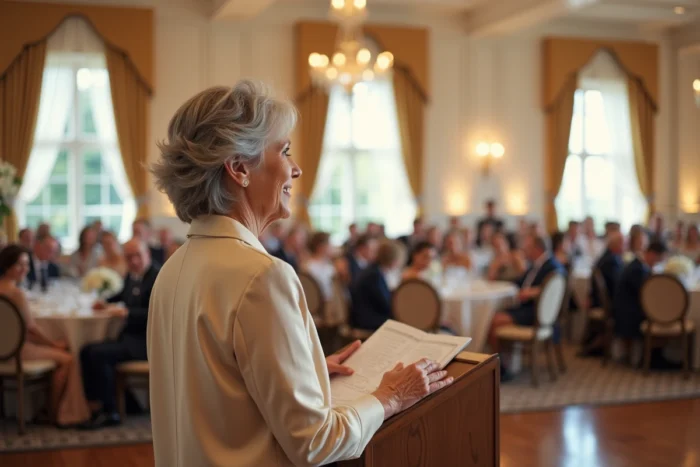
The closing: understated and forward-looking
Ending with a concrete wish for the couple works better than a lyrical flourish. A simple wish, related to what has been shared in the speech, naturally wraps up the address.
Common mistakes in the groom’s mother’s speeches
Feedback shared on wedding forums highlights recurring mistakes that turn a moment of emotion into a source of discomfort.
- Talking too much about oneself and not enough about the couple: the mother’s speech is not an autobiography; it is a verbal gift addressed to the newlyweds
- Comparing the groom as a child to the adult groom in a “you were unmanageable, now you are tamed” manner: this type of humor can infantilize the groom in front of his peers
- Forgetting to mention the partner: a speech focused solely on the son excludes half of the couple
- Reading a template found online without personalizing it: guests immediately perceive a generic text, and the emotion falls flat
The groom’s mother’s speech draws its strength from its uniqueness. A short, personal text, reviewed by the couple and delivered in one’s own voice remains memorable long after the cake has been served. Preparation in advance, far from killing spontaneity, frees the speech on the day and allows for fully experiencing this moment without unnecessary stress.