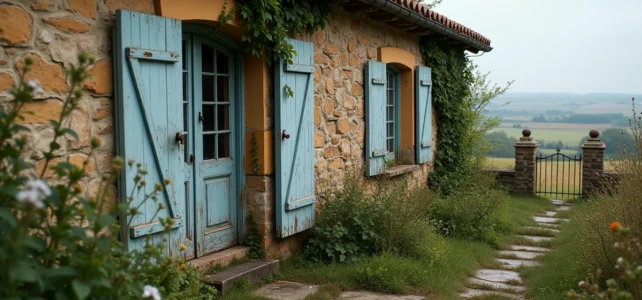
Every year, thousands of homes remain vacant in the French countryside. Their owners have passed away, are untraceable, or simply uninterested. Faced with this reality, one question often arises: can you really recover an abandoned house without paying anything? The short answer: yes, legal mechanisms exist. The honest answer: the word “free” almost always conceals real costs.
Non-negotiable costs of an allegedly free abandoned house
Before looking for where to find a property, it is essential to understand what “free” means in this context. The purchase price may be zero, but the acquisition never is. Even in a donation between individuals or a municipal transfer at a symbolic price, several expense items come into play.
- Notary fees cover the drafting of the authentic deed, land registration, and associated taxes. They are due regardless of the displayed sale price.
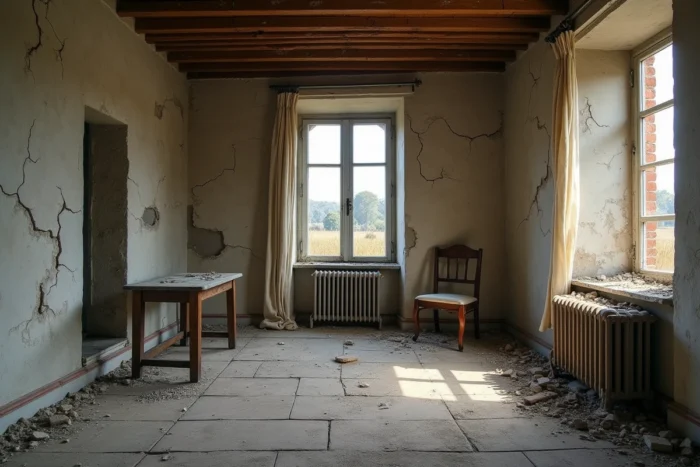
- The cost of renovation constitutes the main expense. For a property abandoned for years (collapsed roof, non-functional installations, cracked walls), the budget for restoration sometimes exceeds the final value of the home.
- Mandatory technical diagnostics (asbestos, lead, termites depending on the area) also incur costs, and their results may reveal additional heavy work.
A buyer consulting the information provided by EuropImmo will find a useful overview of the different acquisition paths. The common point among all these paths remains the same: without the financial capacity for the work, the project will not succeed.
Municipal transfer at a symbolic price: what municipalities really require
One-euro house programs are the ones that most fuel online searches. Rural municipalities do indeed offer properties at symbolic prices to attract new residents and combat housing vacancy. Saint-Amand-Montrond remains the most frequently cited example.
But the town hall does not give away a house like one would offer a piece of furniture on a classified ads site. Have you noticed that these programs all require an application file? The conditions are strict and verified.
Commitments required by the municipality
The candidate must commit to living in the property and to carrying out rehabilitation work within a set timeframe. The municipality generally requires a solid financing plan, sometimes accompanied by a detailed construction schedule.
If these commitments are not respected, resolutory clauses allow the community to reclaim the property. The symbolic acquisition thus functions like a contract: a reduced price in exchange for specific obligations of renovation and occupancy.
This system is primarily aimed at families or project holders capable of mobilizing a significant budget for restoration. A first-time buyer without a contribution has little chance of having their application accepted.
Ownerless properties and the manifest abandonment procedure in 2026
Aside from municipal transfers, two legal procedures allow a municipality to reclaim an abandoned property and, potentially, to transfer it afterward.
Ownerless properties
A property is said to be “ownerless” when the owner has died without a known heir, or when the succession has been rejected. Only the municipality can incorporate this property into its domain, after an investigation and publicity procedure. An individual cannot unilaterally decide to “recover” an empty house just because it appears uninhabited.
The declaration of manifest abandonment
When a property shows visible signs of degradation and the owner does not respond to formal notices, the town hall can initiate a manifest abandonment declaration procedure. This leads, after several administrative steps and a court appearance, to the transfer of ownership to the municipality.
Why does this distinction matter? Because in both cases, it is the local community that becomes the owner first. An interested individual must then negotiate with the town hall, not move in directly. Occupation without title (squatting) remains illegal and does not constitute a path to acquisition.

Donation between individuals: the most realistic case in 2026
Family donations represent the most common scenario. An elderly owner, unable to bear the maintenance costs or property taxes, prefers to transfer the property rather than let it deteriorate. Since February 2025, a temporary exemption scheme allows for the donation of money intended for the acquisition of housing with a tax advantage, within limits defined by the finance law.
The donation of real estate must go through a notarial deed. Even if the donor does not ask for any price, transfer duties and deed fees apply. The cost varies depending on the relationship between the donor and the beneficiary: the more distant the relationship, the higher the bill.
Outside the family circle, receiving a house as a donation from a stranger remains extremely rare. Platforms advertising “houses to give away for free” most often redirect to properties at very low prices, not to genuine donations.
Identifying the owner of an abandoned house: the first concrete step
Before any action, it is necessary to know who owns the property. Consulting the land registry at the town hall or online provides the parcel references. The land registration service then allows you to obtain the name of the current owner.
If the owner is identified, you can contact them to propose a buyout or a donation. If they are untraceable or deceased without an heir, the town hall becomes your contact for vacant property procedures.
A notary is involved at every stage of the property transfer. Attempting to bypass this step exposes you to lengthy and costly disputes, especially when heirs reappear after the sale.
Obtaining an abandoned house for free or at a symbolic price remains possible in 2026, but the typical profile of the accepted candidate is not that of a bargain hunter without a budget. It is that of a solid project holder, ready to invest in renovation and commit long-term to a municipality or donor. The true cost of a “free” house is measured in work, administrative steps, and patience.