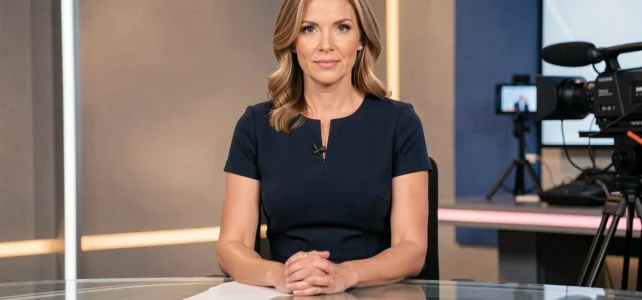
The query “Aurélie Casse thigh” frequently appears in search suggestions. This persistent volume reflects a well-established reflex: reducing a television journalist to a cutaway shot of her legs, while her professional journey on France 5 deserves full attention.
Algorithmic loop and bodily queries: how the web perpetuates the problem
When a user types “Aurélie Casse thigh” or “Aurélie Casse legs,” the search engine records the query. The more it is typed, the higher it rises in automatic suggestions. Websites then produce optimized content on this keyword, generating new clicks, and the loop closes.
This self-reinforcing mechanism explains why the query does not disappear despite the absence of new facts. The visibility architecture of the web transforms a momentary curiosity into a permanent subject, often without the public being aware of it.
The same pattern can be observed for other female presenters: as soon as a studio shot reveals a physical detail, the mechanism kicks in. When we look at Aurélie Casse’s legs analyzed from this technical angle, the conclusion is clear: the problem is not an individual’s curiosity, but a system that rewards this curiosity by making it increasingly visible.
Television framing on talk show sets: the role of seated shots
Talk shows like C l’hebdo or C à vous use set configurations with low chairs and coffee tables. These scenographic choices produce wide shots where the legs of seated individuals occupy a significant part of the frame.
The framing creates the exposure, not the presenter. A man in a dark suit sitting in the same chair does not generate any equivalent query. The asymmetry is structural: it relates to the expected clothing (dress, skirt) and the camera angle.
The EBU (European Broadcasting Union) has published recommendations asking broadcasters to limit shots that unnecessarily sexualize individuals on air. These guidelines, welcomed in the sports field, apply equally to news sets. Specifically, this means:
- Favoring chest shots or medium shots rather than wide low-angle shots of seated individuals
- Reducing the duration of cutaway shots that isolate a body part unrelated to the editorial content
- Training camera operators to identify angles that inadvertently produce a sexualization of the filmed subject
These technical adjustments can be made without altering the overall scenography of a show. We are talking about choices of focal length and camera height, not a redesign of the set.
Gendered searches on female journalists: a measurable bias
Queries associating female TV presenters with bodily terms (“legs,” “cleavage,” “dress”) are described as much more frequent than for their male counterparts. This imbalance is not anecdotal: it structures the way the public perceives female information professionals.
Aurélie Casse is not an isolated case but a symptom. The same phenomenon affects presenters on BFMTV, TF1, or France Télévisions. The difference lies in the search volume, not the nature of the bias.
Concrete impact on newsrooms and careers
When a journalist knows that each appearance on air generates comments about her appearance rather than her editorial work, it produces measurable effects on her professional daily life:
- A dress code pressure that does not exist for male presenters, where the suit and tie neutralize any bodily attention
- A diversion of professional notoriety towards physical notoriety, complicating credibility during political or economic interviews
- A documented discouragement among young female journalists who hesitate to apply for on-air positions
Aurélie Casse has hosted two seasons of C l’hebdo on France 5 and has taken over the first part of C à vous in place of Anne-Élisabeth Lemoine. This type of editorial responsibility relies on managing live broadcasts and conducting interviews, not on physical appearance.

Aurélie Casse on France 5: an editorial journey that queries erase
Reducing Aurélie Casse to a bodily query amounts to erasing a journey built on verifiable skills. Hosting a weekly talk show on a public service channel requires mastering the relaunch of political guests live, managing a multi-guest set, and adhering to an editorial line under time constraints.
The transition between Anne-Élisabeth Lemoine and Aurélie Casse was not decided based on physical criteria. France Télévisions entrusts this type of replacement to profiles capable of maintaining the audience and the editorial quality of a daily slot.
The problem goes beyond the individual question. As long as search engines reward bodily queries with dedicated content, and as long as television sets maintain framing that unnecessarily exposes the bodies of female presenters, the loop will continue to turn. Changing things requires acting on both levers simultaneously: the technical choices of production and the editorial responsibility of the sites that exploit these queries.