
A field training refers to any educational setup where the learner acts in a real professional environment: workshop, construction site, office, point of sale. The action, material constraints, and interaction with colleagues or clients form the foundation of learning.
Digital platforms today cover a large part of the skills development market, with short formats accessible from a smartphone and often fundable via the CPF. The question is not to oppose them, but to understand what the field conveys that the screen cannot replicate.
Tacit skills and learning in the workplace
The concept of tacit skill encompasses everything that cannot be formalized in a course material: adapting a sales pitch to a client’s body language, adjusting the pressure of a tool according to the resistance of a material, managing a logistical surprise in real time. These know-how skills are built through repetition in an authentic context.
The AFEST (Action de Formation en Situation de Travail), framed by the Avenir professionnel law, formalizes this logic. It imposes two distinct phases: a real work situation, followed by a reflective phase where the learner analyzes what they did and why. Digital can document the reflective phase, but the situation itself requires a physical environment.
Programs that combine online modules and AFEST sequences achieve stronger transfer results in the workplace than 100% distance learning programs. Those looking to deepen this intersection between digital training with clubformationdigital and concrete experience find useful insights into the limitations of fully online training.

Qualiopi and proof of results: what the framework demands from the field
Since decree n° 2026-728 of August 1, 2026, the national Qualiopi framework has tightened its requirements on the actual quality of results, with a particular focus on distance training. The indicators are rewritten to measure the concrete effects of training actions, not just the immediate satisfaction of learners.
For certified organizations, this changes the game. Documenting a result in a work situation requires an observable field. An online quiz validates declarative knowledge, not the ability to execute a technical gesture under time or safety constraints.
The framework now distinguishes between the quality of educational content and the quality of teaching, particularly for learning. An organization that offers only distance learning must prove that its learners achieve the same level of operational mastery as in-person training, which often requires adding field sequences to satisfy the audit.
CPF subcontracting and impact on online training
Decree n° 2023-1350 of December 28, 2023, prohibits cascading subcontracting for actions funded by the CPF. From April 1, 2024, an organization can no longer delegate the execution of training to a subcontractor who in turn delegates it to a third party.
This measure directly affects all-digital players who resold catalogs produced by others. It pushes organizations to master the educational chain from start to finish, including the field phases they previously outsourced. The result: more salaried trainers intervening in real situations, less generic content purchased under white label.
Evaluation of professional skills: the limits of digital alone
Evaluating a professional skill requires checking three dimensions: knowledge (theory), know-how (gesture, procedure), and soft skills (posture, adaptation). Digital platforms adequately cover the first dimension, partially the second through simulations, and very poorly the third.
- An online test measures whether a technician knows the safety standard, not whether they adhere to it when production pressure rises.
- A sales simulation evaluates the structure of an argument, not the ability to read a buyer’s hesitation in face-to-face interactions.
- An e-learning module on management teaches feedback principles, not how to manage a conflict between two colleagues in an open space.
Evaluation in real situations remains the only reliable way to validate complete operational competence. This is indeed the logic of validation observed through field observation, used in certification and VAE processes.
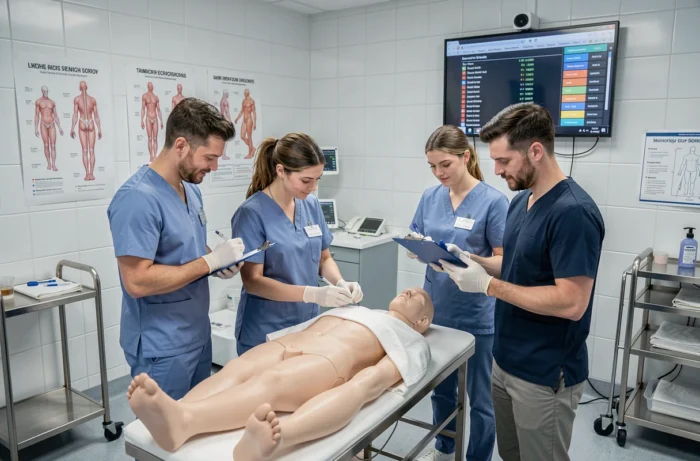
Hybrid pathways: articulating digital and field without opposing them
The most effective format is neither fully in-person nor fully digital. A well-designed hybrid pathway uses each modality for what it does best.
- Digital upfront: acquisition of theoretical knowledge, at one’s own pace, with continuously accessible resources.
- Field at the center: supervised practical application, confrontation with real constraints, immediate feedback from the trainer or tutor.
- Digital downstream: memory anchoring through spaced reminders, self-assessment, access to reference resources to consolidate learning.
This architecture respects Qualiopi’s requirements for effective monitoring of distance learning while ensuring proof of field results. It also allows for reducing time spent in person without sacrificing the quality of transfer in the workplace, a budgetary argument that companies understand.
What the field brings to skill retention
Procedural memory, which encodes gestures and automatisms, is consolidated through repeated physical practice. A learner who has handled equipment for three days in a workshop retains their bearings several months later. The same learner who has only watched video tutorials loses a significant portion of their knowledge in a few weeks without practice.
This difference in retention explains why sectors with a strong gestural component (healthcare, construction, industry, hospitality) maintain high volumes of field training despite the rise of digital. The cost per hour of training is higher in person, but the cost per skill actually acquired and retained can turn out to be lower.
Digital transforms access to knowledge and the flexibility of professional training pathways. It does not replace the moment when a learner confronts the reality of a position, a tool, or an interlocutor. Recent regulatory changes, particularly the tightening of Qualiopi and the regulation of the CPF, reinforce this requirement for proof from the field. Building a solid pathway requires articulating both modalities, not choosing one by default.